Sustainability

Why CO₂ Belongs in Your Product Cost Analysis from Day One


For most technology planners, CO₂ emissions have historically sat outside the cost calculation. That is changing fast. EU regulations are putting a real price on carbon, and that price is rising. The gap between where regulations are heading and what most planning processes account for is closing faster than many teams expect.

At the Tset Summit 2025 in Munich, we brought together manufacturing industry leaders, cost engineers, and researchers to explore the intersection of cost engineering and sustainability. One of the standout sessions came from Prof. Dr. Jana Backes from RWTH Aachen University. Her talk, "Emissions in Technology Planning: The Relevance of a Standardized Sustainability Assessment," made a clear case that CO₂ emissions are no longer just an environmental concern. They are a cost factor that technology planners can no longer afford to ignore.

Read the main takeaways from this session.

Emissions Are Becoming an Economic Reality

Prof. Backes opened with a straightforward message: sustainability assessment has moved out of the ecological lane and into the financial one.

Sustainability is no more just an ecological issue or a private thing by people who like sustainability. It is a thing which becomes more and more economic and more and more relevant for technology planning and for cost efficiencies.


Regulatory frameworks like the EU Emissions Trading System (EU-ETS) and the Carbon Border Adjustment Mechanism (CBAM) are already pricing CO₂ into the supply chain. At the time of the summit, the EU-ETS price stood at around €55 per tonne of CO₂, with projections reaching up to €120 per tonne and full pricing of emissions expected from 2034 onward.
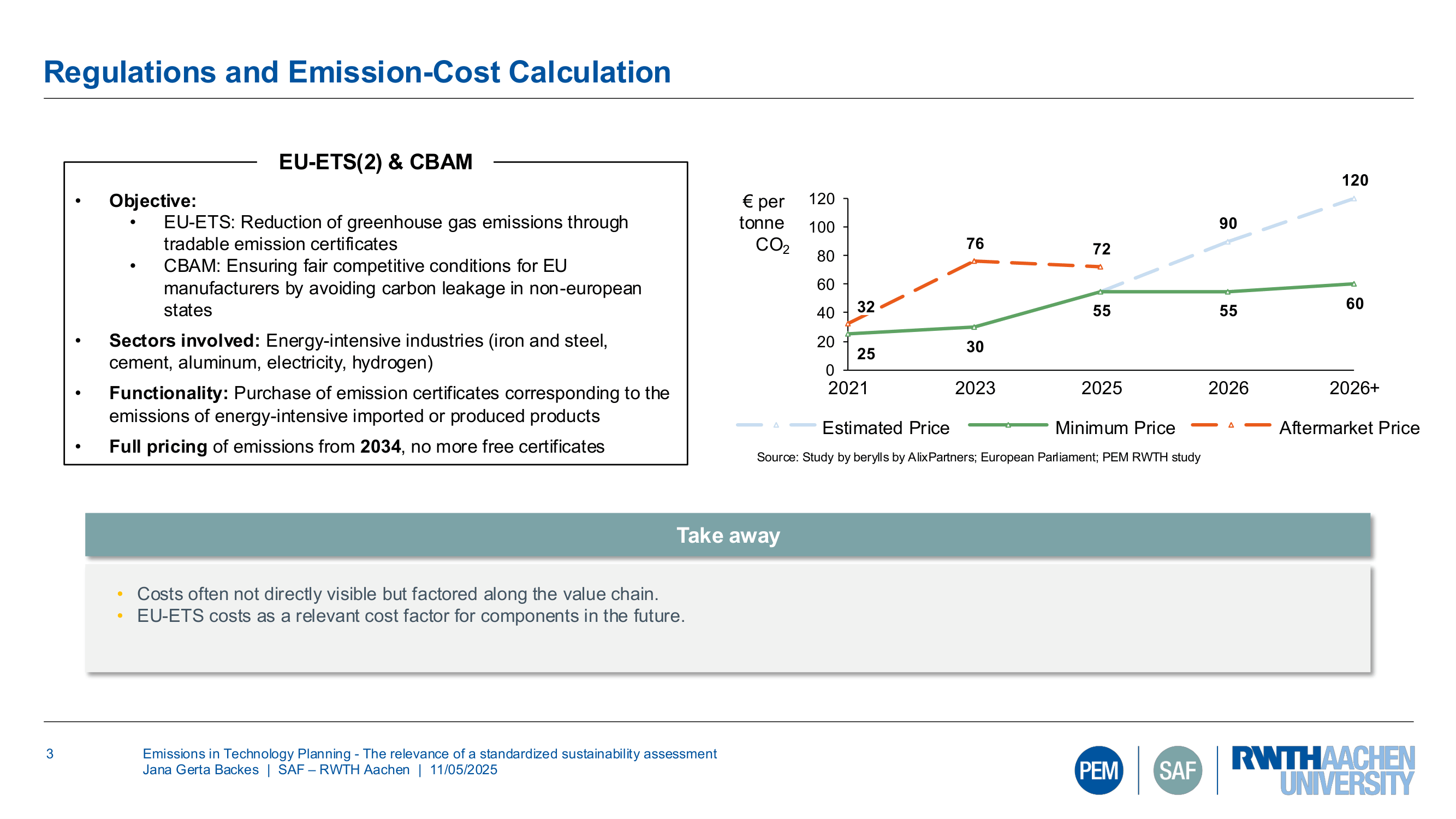
Presentation slide explaining EU-ETS and CBAM regulations with a chart showing projected CO₂ price increases over time.

This shift has a direct impact on product cost analysis. Emissions costs are often not visible in a line item, but they travel through the value chain and will increasingly surface as a concrete cost factor for components.

The Break-Even That Changes Technology Decisions

To put numbers to the argument, Prof. Backes presented a head-to-head comparison of two technologies with the same functional output.
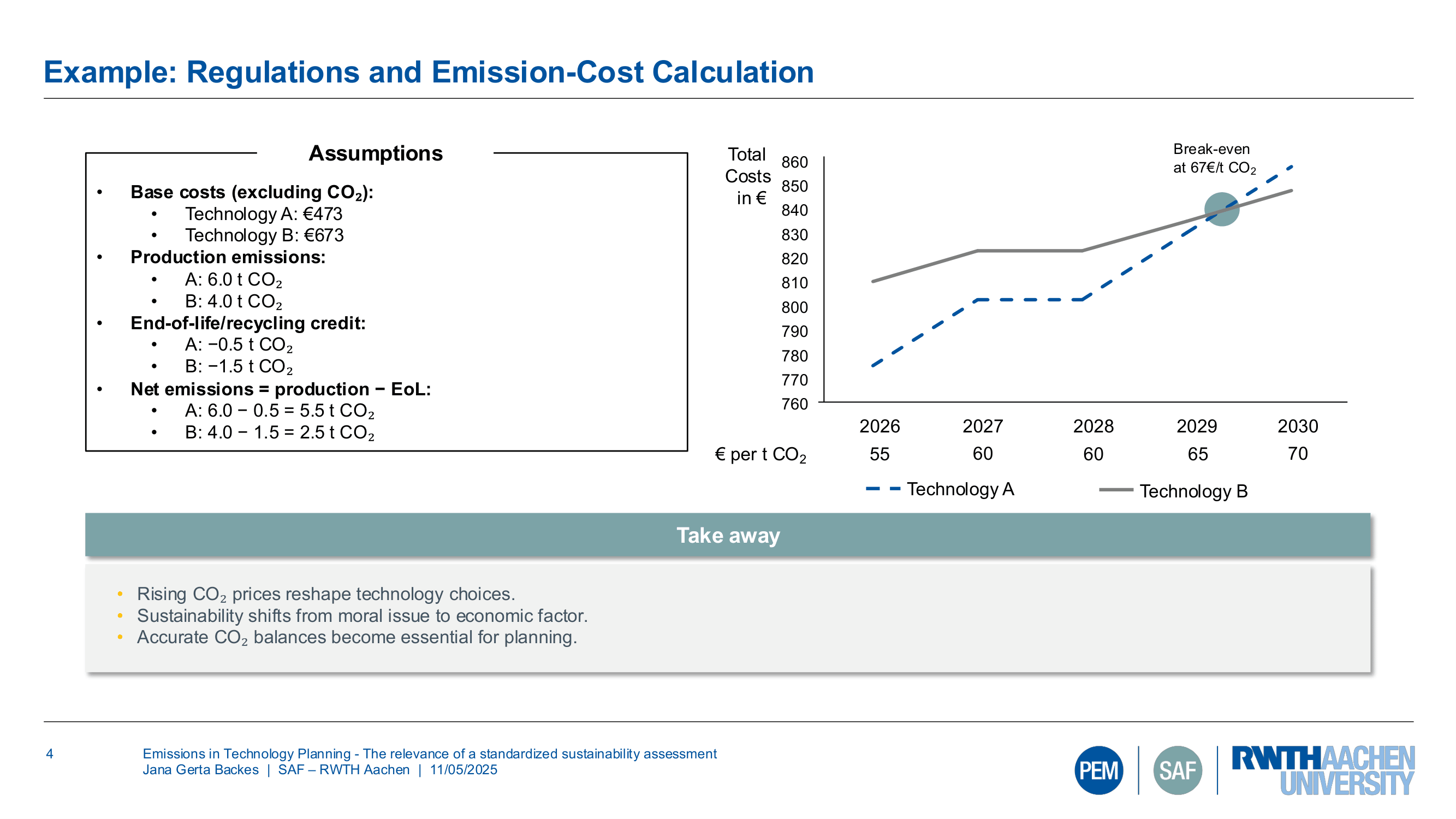
Presentation slide showing cost comparison of two technologies under rising CO₂ prices, including assumptions and break-even analysis.

Technology A has a base cost of €473, while Technology B costs €673. On base costs alone, the choice is clear: pick A. However, factor in production emissions and end-of-life recycling credits, and the picture changes. Technology A carries a net emission load of 5.5 tonnes CO₂, compared to 2.5 tonnes for Technology B. At a CO₂ price of €67 per tonne, which is only marginally above current levels, the two technologies reach a break-even. Above that threshold, Technology B becomes the less cost-intensive option over the full lifecycle.

Rising CO₂ prices reshape technology choices. Accurate CO₂ balances become essential for planning.


This example captures exactly why product costing needs to extend beyond production costs and into lifecycle thinking. Early decisions carry the most leverage, and the opportunity to influence total cost shrinks the later in the lifecycle you act.

The Problem: LCA Results Are Not Comparable

Lifecycle assessment (LCA) is the established method for evaluating environmental impact across a product's full lifecycle, from raw material extraction through to end of life. Prof. Backes explained why, despite ISO norms and widespread use, LCA results often cannot be reliably compared across companies or even within the same organization.

Three challenges stand out:

1. Data variability

The same steel coil yields a carbon footprint of 1.69 kg CO₂e per kilogram in one database (Ecoinvent v3.9) and 1.98 kg CO₂e in another. Scaled across a full vehicle or machine, that gap is substantial. 

2. Methodology differences

Impact assessment methodologies treat greenhouse gases differently. Under the ReCiPe method, methane is weighted at 36 times the impact of CO₂. Under CML-IA, that factor is 28. Two companies assessing the same component can arrive at very different numbers without either one being wrong.  

3. Tool fragmentation

Many companies still rely on Excel for carbon footprint calculations. For a basic product carbon footprint, that may work. For multi-indicator assessments covering acidification, eutrophication, or ozone depletion, it does not. Without shared tools and transparent methodology, cross-company comparison becomes unreliable.

If people are not communicating officially what they did and what they used, then comparison is gone. And then we can also leave any environmental assessment and any pricing on CO₂ emissions.


The Path Forward: Standardization and Integration

Prof. Backes closed with a call to action for the industry. Standardizing LCA methodology, integrating carbon accounting into ERP systems, and using AI and machine learning to improve data quality and consistency are the steps needed to make sustainability assessment credible and comparable at scale.

The convergence of cost engineering and carbon accounting is not a future scenario. It is already underway. The question for cost engineers, procurement teams, and technology planners is whether their tools and processes are ready to reflect that reality.

Want to watch the full session?

Watch this session to learn why emissions must be considered early in technology planning as a decisive economic factor, not just a sustainability metric.

Watch now


Interested in attending Tset Summit 2026? We will be announcing the next edition soon. Follow Tset on LinkedIn and subscribe to our newsletter to be among the first to receive your invitation.

What is the EU Emissions Trading System (EU-ETS) and how does it affect product costing?

The EU-ETS is a regulatory framework that requires companies in energy-intensive industries to purchase certificates for every tonne of CO₂ they emit. For manufacturers, this means emissions are increasingly reflected in component costs throughout the supply chain, even when they are not listed as a separate line item. At current pricing levels of around €55 per tonne of CO₂, the impact is already measurable. With full emissions pricing expected from 2034 onward and projected prices reaching up to €120 per tonne, CO₂ costs will become a significant factor in any serious product cost analysis.

Why should CO₂ emissions be included in technology planning from the start?

The opportunity to influence both cost and emissions decreases significantly the later in the product lifecycle a decision is made. When CO₂ pricing is factored in early, alongside production costs and end-of-life considerations, technology choices can look very different. As Prof. Backes demonstrated at Tset Summit 2025, a technology that appears cheaper on base production cost can become the more expensive option once lifecycle emissions and rising CO₂ prices are accounted for.

What is lifecycle assessment (LCA) and why is it relevant for cost engineers?

Lifecycle assessment is a standardized method for evaluating the environmental impact of a product, process, or material across its full lifecycle, from raw material extraction through to end of life. For cost engineers, LCA is becoming directly relevant because CO₂ emissions now carry a regulatory price tag. Understanding where emissions are generated across a product's lifecycle is the first step toward accurate carbon cost planning and more competitive product costing.

Why are LCA results often not comparable across companies?

Two main factors drive inconsistency. First, different emissions databases assign different CO₂ equivalent values to the same materials. The same steel coil, for example, yields 1.69 kg CO₂e per kilogram in one database and 1.98 kg CO₂e in another. Second, impact assessment methodologies weight greenhouse gases differently. Methane is treated as 36 times more impactful than CO₂ under the ReCiPe method, but only 28 times under CML-IA. Without a standardized approach, cross-company comparison of carbon footprints remains unreliable, which makes pricing CO₂ into supplier negotiations or RFQ processes difficult.

Can product costing software help integrate CO₂ data into cost calculations?

Yes. Dedicated product costing software that combines cost and carbon footprint data in a single calculation gives cost engineers the visibility they need to make informed technology decisions. Tset calculates both cost and CO₂ output by default, with every result, making it possible to run the kind of lifecycle cost analysis that Prof. Backes described, without switching between disconnected tools or relying on Excel-based carbon calculations.

What is the Carbon Border Adjustment Mechanism (CBAM) and who does it affect?

CBAM is an EU regulation that extends carbon pricing to imported goods, with the goal of creating fair competitive conditions for EU manufacturers. It applies to energy-intensive sectors including iron and steel, cement, aluminum, electricity, and hydrogen. For procurement teams sourcing components from outside the EU, CBAM means that the carbon intensity of supplier production will increasingly translate into direct cost implications, making carbon footprint data a procurement consideration alongside price and quality.


Continue reading

Get notified — new blog articles, straight to your inbox.

Get monthly updates on engineering, sustainable manufacturing, and smarter product decisions.

Blog updates