The Benchmarking Gap
Why Chinese OEMs are pulling ahead
About the episode
Every year, A2MAC1 tears down around 70 vehicles, analyzing everything from battery cell chemistry to semiconductor sourcing. For over 25 years, the company has built one of the most comprehensive automotive benchmarking databases in the world.
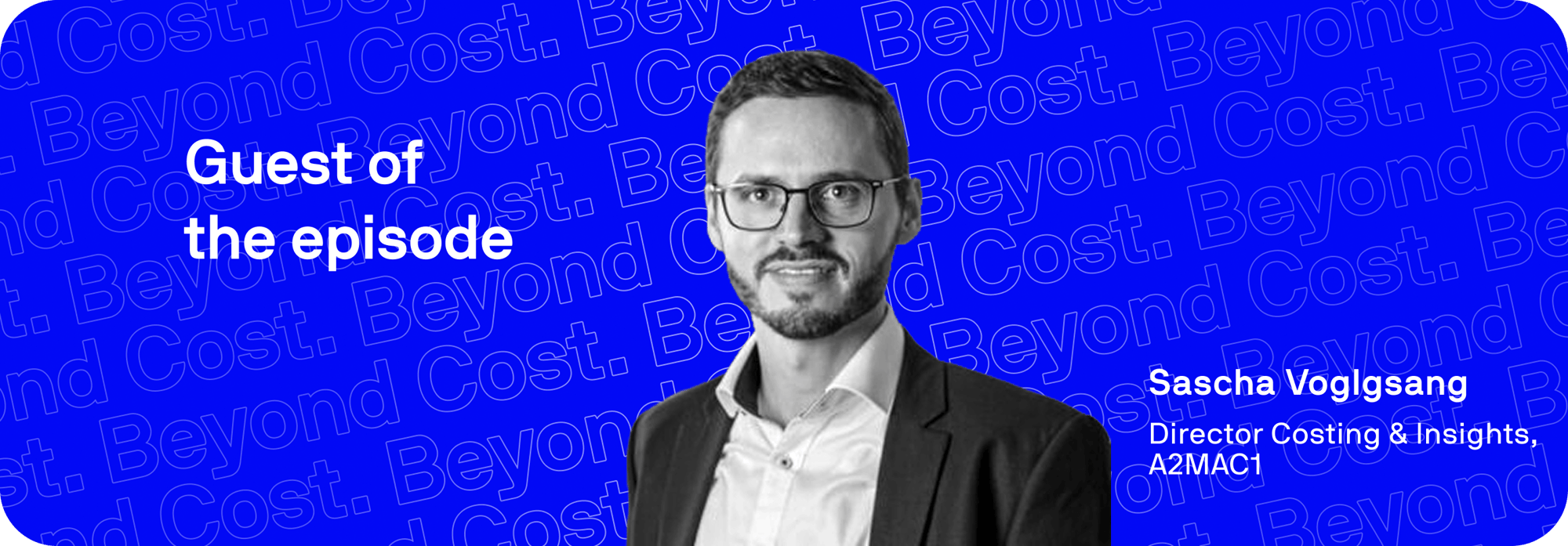
Sascha Voglgsang, Director of Costing and Insights, works at the intersection of teardown analysis, standardized costing, and market intelligence. His work reveals how architecture decisions, supply chain strategy, and integration levels translate into cost advantage or cost burden.
In this conversation with host Sasan Hashemi, Sascha Voglgsang explains what Benchmarking at industrial scale really requires and how AI is beginning to change how cost insights are extracted from massive engineering datasets.
In this episode, you will learn:
- Why scale and standardized methodology determine the value of Benchmarking
- How integration trends reshape EV cost structures
- What supply chain localization reveals about long-term competitiveness
- How AI can support cost engineering without replacing expert judgment
- Why continuous yearly iteration outpaces long platform cycles
The data is available. The real question is whether your organization is able to turn it into competitive advantage.



Read the full conversation below
Episode transcript
Sasan Hashemi (Host): Welcome to another episode of Beyond Cost. Today I am here with Sascha Voglgsang. He is the Director of Costing and Insights at A2MAC1. A2MAC1 is the biggest automotive benchmarking service provider in the world. You're leading that field, and today we will talk about benchmarking in general, how it is shaping the industry, how it is generating insights, what are best practices, and what the future holds for such an important segment when it comes to market intelligence. Thank you for coming, Sascha. It's awesome to have you. Maybe for the viewers, could you quickly introduce yourself?
Sascha Voglgsang (Guest): Yes, my name is Sascha Voglgsang, Director of Costing and Insights at A2MAC1, as you said. My pleasure to be here today.
Sasan Hashemi: Yeah. So Sascha, before we get into the nitty-gritty of benchmarking in the automotive industry, let's talk about you a bit. So you are a technical guy, is that correct? Could one say that?
Sascha Voglgsang: I would definitely say so, yes.
Sasan Hashemi: You studied engineering in Germany and went into… I saw that one of your first stops was actually the Fraunhofer Institute. Could you elaborate a bit on that?
Sascha Voglgsang: So I have a bit more scientific background, so to say. I studied mathematics and physics, so more theoretical actually. And then I made my way into something which is more hands-on, more tangible, disassembling parts. I joined a company, a small consultancy in cost engineering, where I started to take parts apart and try to understand the technologies behind them and explore some findings out of it.
Sasan Hashemi: Yeah. So that small consultancy was based in Munich, right? And you were focused on cost engineering. That was roughly 10 years ago.
Sascha Voglgsang: Exactly.
Sasan Hashemi: And how was it, as someone who comes from a mathematics and physics background, getting into basically manufacturing models of parts in the automotive industry? How was that experience for you?
Sascha Voglgsang: For me it was super exciting because we were acting in different areas and different industries. You always had something new. You explored different technologies. You checked green energy, solar inverters, and you investigated first parts in automotive where power electronics came into the car, where you were exploring EVs and so on. So it was very exciting stuff. For me, with my very analytic background, it was always nice to match this and cluster it by functions and try to understand how things are working and what I can really learn out of it. This combination of something which is more scientific with something which is very hands-on—I really enjoyed this.
Sasan Hashemi: And here's a question we always ask people on the podcast who got into cost engineering, because it's such a specific field. Is it something that you consciously decided to do, or did you just kind of slip into that and found it interesting?
Sascha Voglgsang: I would say I slipped into it.
Sasan Hashemi: Yeah?
Sascha Voglgsang: That was not a decision by intent. But with being very curious and taking parts apart and understanding products and technologies, one obvious dimension is: what does it cost? And how can I make it more cost-effective? How can I implement more functions with smaller money, so to say? I found this very exciting—building the most performant products, exploring cost optimization ideas, but still keeping the function and the value and optimizing the value of the product in the end.
Sasan Hashemi: I see. And you already started taking products apart. Benchmarking is a well-established practice, especially in the automotive industry, but also in other industries. However, the word benchmarking itself is used in a very inflationary way. You hear it a lot: “Let's benchmark that”, “What's the market benchmark on this?” Could you explain from the perspective of a leading provider in that space what benchmarking really is and why someone does it?
Sascha Voglgsang: I think the fact that benchmarking is used in so many different ways shows the many dimensions benchmarking has. For me, benchmarking is really about understanding how a product is working. Understanding which performance it has and also all the other dimensions attached to it, like cost. What is the cost to realize a function? What is the best technology to realize this function? And “best technology” already comes with many different characteristics. It can be driven by most efficient, it can be driven by most cost-effective, it can be driven by most carbon-footprint-effective. It can also be the leanest way to produce a part. So benchmarking for me is really investigating a product along those different characteristics, categories, functions, and properties to come to one conclusive statement and find what is the best product.
Sasan Hashemi: Maybe you could elaborate a bit more on that. How do you define the best product, especially in the automotive industry? If I look at the powertrain, what are normally the questions where you as a benchmarking provider have the answers?
Sascha Voglgsang: I think this starts at a very high level. In the end a car is also a product, right? A car is a product which is relevant for a user group. So what is the user group demanding? The user group for an electric car is demanding range, charging speed, and so on. Those properties you need to investigate first. Then it comes down to how you implement this functionality. How do you implement fast charging? Do you do it with separate modules and a very discrete architecture, or a more integrated way? Then the next question is which components you use. Which semiconductors you use. So there is a funnel from a certain function that you need to provide to the buyer of the car down to system architecture and component level. Nowadays there are hundreds of different ways how you can implement this function, and that makes it very exciting.
Sasan Hashemi: As you explain it, it seems like benchmarking is basically an intrinsic part of the product development process and strategy. I guess a lot of people—even outside automotive—are benchmarking without realizing it. How come that such an important activity is outsourced to a central company like yours?
Sascha Voglgsang: I would say that is driven by quantity and quality. Benchmarking is widespread in the automotive industry. All OEMs do some kind of benchmarking internally. But they cannot manage to do the same thing across different regions for 70 vehicles per year. If you really want to have conclusive coverage of different markets and understand how newcomers in China are performing versus legacy OEMs in Europe or the US, you need scale. The second aspect is the structured and standardized way of analysis. We go very granular in our investigations, down to battery cell chemistry level, understanding which raw materials are used in the body in white. This combination of scale and deep, structured analysis is the winning recipe.
Sasan Hashemi: And just for the viewers: you tear down around 70 cars every year, part by part. That's a huge operation. You have multiple facilities where these cars are torn down and measured. How does that process actually work?
Sascha Voglgsang: Essentially the process starts even earlier. Someone needs to decide which cars to disassemble. What are the exciting cars entering the market. Then we purchase those cars. This is driven by customer demand but also by our internal expertise. The first step is a full 3D scan of the vehicle.
Sasan Hashemi: Before you tear it down?
Sascha Voglgsang: Exactly.
Sasan Hashemi: So the whole car goes through some kind of X-ray machine?
Sascha Voglgsang: Not X-ray. It's a visual 3D scan. You visually scan the components and then step by step explore the full vehicle. After that you start disassembling the first parts like doors as a complete system. Then you go deeper and deeper. And this also depends on which systems are the most interesting in a specific car. For EVs, everyone wants to go down to the cell chemistry and battery pack. For other cars that might be less relevant. So depending on the technology we decide where we go deeper down to raw material analysis or semiconductor identification.
Sasan Hashemi: I just wanted to say, depending on the component, you have to look at different things, right? If you want to check the manufacturability of a seat with a bunch of sheet metal parts, that’s very different than looking at battery cells.
Sascha Voglgsang: Exactly. And that’s also how our services are shaped.
Sasan Hashemi: So you have the battery guys, and then you have the door guys and the chassis guys. Basically different specialists. That’s quite interesting. And this has grown a lot over the last years. You started around ten years ago in this field, but the organization has grown quite a lot since then, right?
Sascha Voglgsang: Yes, exactly. One dimension of growth is simply analyzing more cars. The other dimension is going deeper in terms of granularity. When we later speak about costing, one element is which properties you need as input to perform proper costing, a detailed and accurate costing. And that drives the expansion in the level of detail.
Sasan Hashemi: And you are not the only provider on the market that does this. But from our point of view and from our research, you are definitely the leading one. So why are you the best? Do you have more cars, better data, or what is the secret sauce if you can share it?
Sascha Voglgsang: To a certain extent it is experience. A2MAC1 was founded more than 25 years ago. Over this time we really learned what matters to the customer. We have a very customer-centric approach and discuss a lot with our customers to understand which properties they need and which functions they want to analyze. That helped us build a solid base and a structured way to analyze cars. This combination of scale across regions, the right granularity, and the right structure of analysis helped us stay ahead of competitors or fast followers who try to adapt the same approach.
Sasan Hashemi: The benchmark data itself is the context, but as I understand you extract two things from it: value and cost. Before we go into the cost part, you mentioned value earlier. For example, range for EVs or charging time for batteries. The way you parameterize the value of a product depends heavily on engineering teams. How do you balance that to create a set of values that are applicable across different components?
Sascha Voglgsang: For me this starts at the full vehicle level. After that you need domain expertise. Power electronics require a different set of parameters and KPIs compared to batteries. For power electronics it might be power density or compactness. For batteries it might be energy density. So you need expertise in each domain to define the right KPIs.
Sasan Hashemi: And what about something that is harder to quantify, like design? That’s always a tricky topic. There are many intangible parameters when it comes to value.
Sascha Voglgsang: Yes. Many topics can be covered with objective KPIs. But there are also aspects that are more company-specific. For example, interior DNA is specific to an OEM, a segment, or a specific target customer. There it becomes harder to define universal KPIs. Still, there are ways to measure certain functional aspects.
Sasan Hashemi: Very interesting. Now let’s move to cost. Costing is kind of a newer product you have. Could you summarize how that works? You take the benchmark data and then start creating bottom-up calculations?
Sascha Voglgsang: Yes. That’s basically the idea. Originally, A2MAC1 was focused purely on technical benchmarking. Later the company acquired ECS, a small cost engineering consultancy. That allowed us to add cost engineering expertise. Our vision since then has been to evaluate the cost attached to the technologies we analyze. We translate the technical bill of material into a cost structure. But to do that properly we need additional properties and more granularity. For example, to cost a small bracket we need more than weight and dimensions. We need geometry, thickness, and material information. So expanding into costing pushed us to increase the depth of our data.
Sasan Hashemi: So the first step before costing is preprocessing the teardown data to ensure you have all required parameters.
Sascha Voglgsang: Exactly.
Sasan Hashemi: You go into a lot of detail then, like cycle time and machine selection.
Sascha Voglgsang: Yes, exactly.
Sasan Hashemi: And you do that for how many cars per year?
Sascha Voglgsang: Currently, we perform costing for 18 cars per year. But our vision is to eventually cover the full database of around 70 cars annually.
Sasan Hashemi: Doing that 70 times would be a huge challenge for many cost engineering departments. And then there is also the challenge of consistency in methodology. How do you ensure scalability and consistency?
Sascha Voglgsang: Consistency is extremely important. If you compare simple attributes like weight or dimensions, consistency is easy. But cost is more complex. Therefore, we developed standardized costing methodologies for each part type. For example, injection-molded parts must always follow the same methodology across all cars. At the same time the process needs to be scalable. That’s why we invest heavily in automation. We automate what can be automated so experts can focus on the complex cases.
Sasan Hashemi: Your explanation sounds very similar to AI use cases. Is AI an important topic for you?
Sascha Voglgsang: Yes, extremely important. To scale from 18 vehicles to 70 vehicles we need automation. For example, we already use AI internally to extract properties from images. Instead of a cost engineer manually checking hundreds of pictures to identify whether a part is coated, AI can detect that automatically. Another use case is extracting insights from our database. Because we have a very consistent dataset, we can identify cost improvement ideas across vehicles. We call this the cost measure ideator.
Sasan Hashemi: So you already provide concrete improvement ideas based on the benchmark database.
Sascha Voglgsang: Exactly.
Sasan Hashemi: Many people are concerned about AI result quality. How do you ensure reliability?
Sascha Voglgsang: It starts with the data. The raw data foundation must be extremely accurate. If the dataset is inconsistent, AI results will not be reliable. So improving data quality is the first step. The second step is governance. Experts still need to validate the methodology and results.
Sasan Hashemi: You’re also responsible for industry insights. What trends are you currently observing in automotive development?
Sascha Voglgsang: One clear trend is increasing system integration. We see this especially in battery systems moving from cell-to-module to cell-to-pack or even cell-to-chassis. We also see more integrated designs in power electronics. Another trend is localization of supply chains. For example, in BYD’s onboard charger design in 2020 only about 2% of semiconductors came from Chinese suppliers. By 2025 more than 60% come from local suppliers. So there is a clear trend toward local supply chains.
Sasan Hashemi: Is this how you see the market evolving in the future? More integration technically and more localized supply chains commercially?
Sascha Voglgsang: Yes, I think those trends will continue. Localization also has geopolitical drivers and tariff implications. Interestingly it also has carbon footprint implications because localized supply chains reduce transportation emissions. Another important trend is the transition toward software-defined vehicles. Historically vehicles had highly distributed architectures with more than 100 ECUs. Now the industry is moving toward centralized architectures and domain controllers. The next step will be fully software-defined vehicle architectures.
Sasan Hashemi: How do you benchmark software?
Sascha Voglgsang: We cannot disassemble software itself. But we can analyze the electronic architecture, which ECU controls which actuator, and how the systems interact. From there we can derive software requirements and estimate software development costs. We call this Software Cost Value Engineering.
Sasan Hashemi: Maybe we should do another discussion about that topic. Thank you for your time today, Sascha. This was very insightful. Stay tuned everyone. Thank you for watching another episode of Beyond Cost.
Sascha Voglgsang: Thank you very much.
Explore the episode highlights
BLOG
The Benchmarking Gap: Why Chinese OEMs Are Pulling Ahead
Read the highlights from the Beyond Cost Episode 6 with Sascha Voglgsang, as he explains what industrial-scale benchmarking actually requires, what the data reveals about EV cost structures today, and where the competitive gaps between legacy OEMs and Chinese players are widening.