China’s Speed Changes Everything
Hinweis: Die Podcast-Episode ist auf Englisch.
About the episode
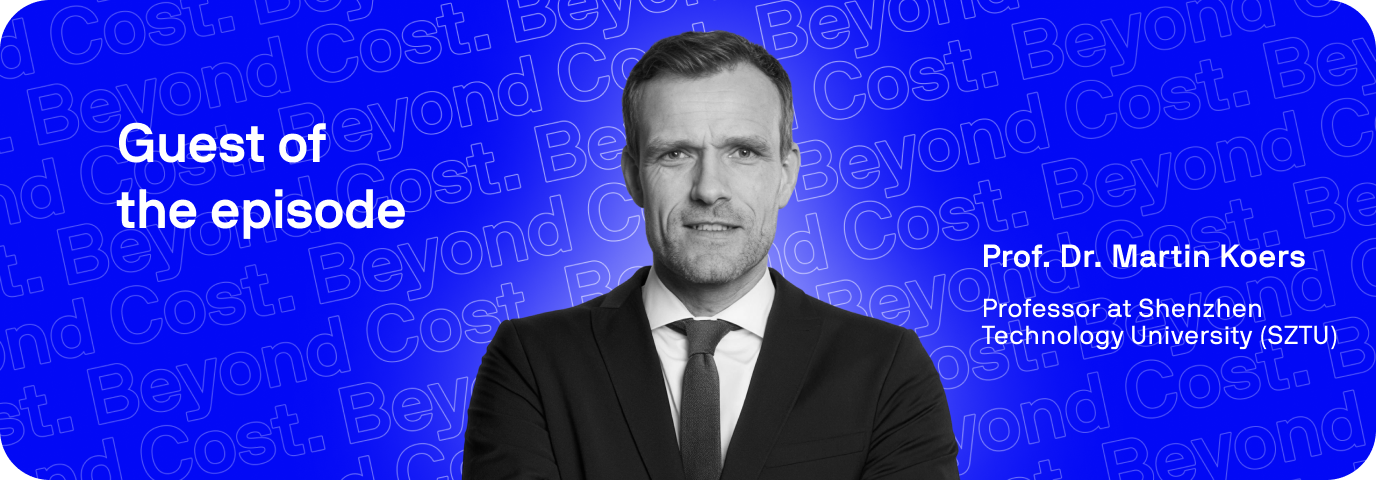
What if German manufacturers aren't losing to Chinese technology, but to Chinese speed? In this episode of Beyond Cost, host Jakob Etzel talks with Prof. Dr. Martin Koers about the one area where German manufacturers still lead: combustion engineering. Then they turn to the three where China has already passed them: battery electric vehicles, software-defined vehicle architecture, and autonomous driving.
Martin Koers ran the VDA, Germany's automotive industry association, for seventeen years and visited China many times, but he didn't understand the real speed of the country until he moved there to teach at Shenzhen Technology University. What he found was a 9-9-6 work culture, a cashless economy, and five-year government plans that set the goal while a brutal domestic market decides who survives.
In this episode, you will learn:
-
Why Germany's edge survives in exactly one of four competitive dimensions, and loses in the other three
-
How centralized decision-making and a different work mentality compress Chinese development timelines
-
Why the lack of software-first design is leaving Germany behind
-
What young Chinese consumers now think of BMW, Mercedes, and Audi
Germany still builds the best combustion engine in the world. The question is whether that's enough, and for how long.



Read the full conversation below
Episode transcript
Jakob Etzel (Host): Hi everyone, and welcome back to Beyond Cost. Our podcast here at Tset. My name is Jakob Etzel. I am heading Customer Success at Tset, and I will be your host for today's episode. And today's guest is Prof. Dr. Martin Koers, Shenzhen Technology University, and the former managing director of the German Association of the Automotive Industry. Martin, it's great to have you here, and thanks for joining this episode. In this episode, we will have a look together at today's challenges in the automotive industry, both in Germany, where you have a very deep understanding, and in China, where you are living and working right now. And we will then take a deep dive into what China's speed really means, how you see that in the businesses, and also how you can even feel that in university, and that we will close the podcast with a bit of an outlook on the future, how we think China and Germany will develop. Maybe also talk about AI. Let's see. But Martin, to kick things off, could you briefly introduce yourself and your background?
Prof. Dr. Martin Koers (Guest): Yes. Thank you very much for inviting me. I am very delighted to give my view on the subjects you mentioned in this podcast. Like you mentioned, my name is Dr. Martin Koers. I spent actually my whole life in the industry, in the automotive industry. I even did my PhD in marketing in the automotive industry, talking about brand management in the car industry, and I actually followed my whole life things that are going on in the car industry. After doing my PhD, I was thinking about staying at university, but eventually I switched into business and I worked for the Ford Motor Company for several years. And then I was asked if I could imagine to switch to the German Association of the Automotive Industry, which is not a typical thing for a marketing guy most of the time, that our technical people or law people that work in association. But at that time, the former president, he asked he was looking for some people that are familiar with marketing and marketing issues because working for an association, the German Automotive Association, is actually representing not a company, but a whole industry and marketing a whole industry to the public, but also to politicians, to government and so on. And so I started to work for the VDA, the German automotive industry, which is representing all the German car manufacturers, all the German truck manufacturers, all the German suppliers in the car industry, but also the body and trailer manufacturers. So the VDA has a very strong voice when it comes to automotive issues, because it's manufacturers and suppliers at the same time. And I worked there for a very long time for more than 17 years later, as a managing director, I was responsible for the IAA, for example, which moved from Frankfurt to Munich, was responsible for all this process. And then there were like kind of changes. And I was asking myself, since I had always contact to university, I always was lecturing. And next to my job at the VDA, I had courses at different universities at the University of Rostock, University of Dusseldorf, and I was always very familiar with working with students. And I thought, if I want to do that more professional in my life, then I need to do it now and then. I had the chance to do that in Shenzhen in China, and I thought, if I don't do it now, I will never do it again. And so I'm very delighted that I got the experience to work in industry, work in an association, and now having the view on the automotive industry coming from university at one of the most interesting places in my opinion currently, which is Shenzhen, the Silicon Valley of China.
Jakob Etzel: Thank you Martin. And by the way, congratulations for transforming the VDA. I really appreciate it. In Munich, the setup where you have the exhibition hall for the boat technical audience. And you also were present directly in the middle of the city and the brands exhibiting there. So I think very good outreach also for the industry, which in any way says a very important voice in German politics, I would say.
Dr. Martin Koers: Yeah, that made it very interesting just to work for the VDA. And when it comes to the IAA, I think we could talk to hours about the IA, how we transformed it to Munich, but that maybe in another podcast. So.
Jakob Etzel: A good idea. let's double down on a topic that you mentioned already having this very interesting position at the VDA. What in the end motivated you to go to Shenzhen? I mean, you could also have become a university lecturer somewhere in Europe or in the US. I think you had stations in your career or in your university life in the US already. So why did you decide to go to Shenzhen?
Dr. Martin Koers: Well, because I'm curious and I'm I wanted to know what it really means. China's speed. You mentioned I worked already at German universities. I worked at a university in the United States, the University of Illinois in Urbana-Champaign. I worked there as a visiting assistant professor as well. And I wanted to get to know China. And of course, as working for the VDA, I was quite often in China, but it was always like flying into China and flying out of China. It is. You think you know China, but you know it by flying in and flying out, but not what everyday life means there. And I think there is no more interesting place actually, currently when it comes to economy and to understand transformation and to understand new technology than China. And when you look at China, if you ask Chinese people, there is no more interesting place in China than Shenzhen, which is once again the Silicon Valley of China. Even Chinese people talk about Shenzhen speed. We talk about China speed because in China everything is going so fast. But Chinese people even talk about Shenzhen speed, because in Shenzhen everything even gets faster. The city is only 40 years old and has 20 million people. It's right next to Hong Kong, which is also from the location. Very, very nice. And you really can see the development of that city, how fast everything is going, and that makes it just interesting. And for me to answer your question, it is working so long in the German car industry. We talk about transformation and we know we need to transform. But the key transformation actually is from the speed point of view going on in China. And to be there and to understand what that means, make me curious to change my position and to go to Shenzhen and to take the opportunity to really understand what transformation means.
Jakob Etzel: Martin, this means you are right now in a double position. You are teaching and you are learning.
Dr. Martin Koers: Correct exactly that.
Jakob Etzel: And speaking about learning, I mean, you have had contact with Chinese businesses in the last years when you lived in Berlin. But now that you are on site in Shenzhen, is there something that kind of surprised you once you actually started living there, something that you were not aware when you did business with China from Berlin?
Dr. Martin Koers: We have other VDA has an office in Beijing and in Shanghai, and therefore I thought to know China, but living there, then you really realize that there is a big, big distance between helicopter knowledge. What what I call helicopter knowledge to fly in and fly out, and the truth that you really realize when you're living there, there is a big difference living there. You feel the intensity of what China really, really means. And like mentioned, the 996, for example, working from 9:00 in the morning till 9:00 in the evening, six days a week, that is not a joke. That is reality. If you talk with Chinese people about 996, you realize it and you really realize it when you're living there or the place where I am living next to my place, there's a new infrastructure project and this infrastructure, it runs day and night, three shifts, seven days a week, and they construct infrastructure in a speed where me coming from Germany, we know how to do infrastructure, of course, but it takes so much time. If you think about the airport in Berlin, I mean, it's worldwide known how long it took. And therefore when you are living there, you realize the different mindset and that is what really is different. Flying in and flying out the mindset of the Chinese people. You get to know when you're living there.
Jakob Etzel: And I mean, you knew China already before you started living there. You've been there before. But if you think like about the average Central European person that maybe never has been to China, what would you say is the biggest misconception? So you mentioned already the China or even Shenzhen speed and the 996 rule. So six times a week, 9 to 9. So I made the maps is 72 hours. It's unbelievable. I think if you would tell students in Germany that when they study automotive industry subjects, like whatever it is, even if marketing and you tell them this is going to be the work model, they will probably quit the lectures and say I will study something else. But like coming back to my question, what would you say is for the average Central European person, the biggest misconception? Is it the speed topic or is it something else?
Dr. Martin Koers: Well, we probably have to differentiate between the average person and business people that are in contact with China. When I talk about the average, person also in my friendships and so on. They think China is a communist country and they compare to the eastern part of Germany at former times. And that is such a misconception because it is a communist country. Yes. But I don't know any country where there is so much competition. It is communist on the one side, but it's a competitive country on the other side. And so doing talking about five year plans, for example, I think the average German person still thinks a five year plan is like a five year plan in the former Eastern Republic of Germany. There's a big difference. The five year plan of the Chinese government is defining clear goals. Where do we want to go? And after defining these goals, it's the market who is showing the way of how to get there. And there is voluntary, a big, big, big competition between companies and the government knows not all of these companies will survive like currently in the car industry. In China, for example, there are hundreds of brands. There are so many brands. Although I spent my life in the street, there are so many brands I just don't know and they will be gone from the market quite soon actually, and the government knows it. But they did it on purpose and those that will survive, they are strong. When you look at the Beijing motor show, there was one slogan of be of BYD saying survival of the fittest. Survival of the fittest is probably not a communist speech. It's not at all for me, it's capitalism. It's like capitalism poor. But that is how they act. And that is, I think, a big misconception of many people that they think is a communist country. And it's only role by centralized decisions. Yes, there are centralized decisions, but below that it's it's competition, pure.
Jakob Etzel: But isn't this in a big dichotomy, like a cognitive dissonance that you have hyper competition in an economic sense, in a society that is actually deeply rooted in collectivism? Yeah. So how do these things go together? Do they go together easily, or is it actually what you say, an everyday challenge for people that the society is a collectivist society, but it now has a double capitalism?
Dr. Martin Koers: No, I don't have the feeling that there is a big miss gap in understanding of the people they are. People are very kind of centralized in their thinking that decisions are done on a, on a, on a, on a level which is not on my level but upper level, for example. But then it comes to a competition and that is for the people, actually a normal thing. And what I realized as well is that the soul of the Chinese people, we always think China is rising, China is getting strong. The mindset of the people is we want to be back where we belong. Till 200 years ago, China was one of the leading countries in the world. And then they had like two centuries of kind of mismanagement, I would call it. And they had like very tough times. But now they are not rising. They are just back and they are back where they belong. that is what people drives. We want to be big. We want we don't want to be that. We are the cheap production place in the world. No, we are not the production place in the world. We are a place where we define new technology, and we don't need the teachers from the Western anymore to teach us how to do it. We can do it by ourselves. And let's say on a on a global stance, this is actually something that we want. We want wealth distributed across the globe. And I mean for humanity as a whole. Of course, it's a benefit if there is more than just 1 or 2 innovation centers, if there is a third and a fourth one, and they bring new technology and in the end, it's a global market, this new technology becomes available to everyone. I think it's a benefit for everyone. But yeah.
Jakob Etzel: Martin, let's let's actually go into the first big chapter of this podcast. Let's speak about what is the perception among German manufacturing leadership of the challenges we have right now, and especially the kind of challenge that China poses. So you have been in contact with the executives in your last years in your VDA role. Would you say that in the last two years, the conversation about China has changed in with automotive executives in Germany?
Dr. Martin Koers: Yes. And that is actually what surprises me so much. We were talking about the long term plans of China. Actually, if you wanted to know where China is going, everything is written down in these long term plans. But suddenly in the automotive industry, it just came like, I don't know from night to day that everybody is talking about the China shock. Suddenly everybody is talking about China and the numbers are really we can't ignore them. I mean, the German car manufacturers in China, they have been very, very, very strong. And if you look at their market share, it just declined. Or if you think about BBA, if you talk to a Chinese person, Chinese person or what BBA means, it's BMW Benz, Audi. This stood for if I want to be successful. I was driving one of these BBA, BMW, Benz or Audi. If you talk to Chinese young people nowadays, of course BBA is still there and they still love also German brands and the German brands still stand for high quality, but they stand for brands of our parents. They stand for brands that are not smart and with smart meaning a computer on wheels and especially young Chinese people. They have. They look at Chinese. Like car brands where they think they are more smart. They are smarter, actually, than traditional Western brands. Although maybe the brand reputation of German brands is still very high. that is what German executives realizes. They realize that there is a China shock. And I asked myself, why is it a shock? We could have seen that. But the question is, how do we react? What are we doing? How do we change that? The Chinese car industry is coming ahead and we are not the teachers anymore. The German manufacturers or the western manufacturers are not the teachers anymore. But in many areas the Chinese manufacturers are leading. If you look at the success vectors of future technology.
Jakob Etzel: But isn't this a topic that the brands have already solved in the last years, that they are perceived as a brand of the older generation, and they need to kind of become on vogue with the young ones again. So I would say this shouldn't be new to some of the German car makers. They probably had a similar problem some ten years ago in Germany already or in Central Europe. So if there is a diagnostics for that, can't you take action?
Dr. Martin Koers: Yeah, I think what we didn't expect, what many German executives didn't expect, is the speed behind it, how fast it went. And when I talked to German executives in China. if you would have asked me five years ago if the German manufacturers will suffer in China. Of course, competition always makes you makes you competing. And there's also there's always pressure coming. But I would always have said, well, the German manufacturers, they know what they are doing and they will they will find solutions of competing against the Chinese manufacturers today. I wouldn't be sure on that anymore. I still see the benefits and the good things of the German manufactures. Of course, we have got very strong brands worldwide and that is also a challenge. The German manufacturers are not only competing in China, they are competing in the United States, in Europe and everywhere. And the Chinese manufacturers, they are mainly in China. And therefore we have to distinguish if we talk about transformation, I mean, the German manufacturers, they have to transform the Chinese manufacturers. They are starting right away with the new. And what is the new? And that is that is the key challenge actually the in the new areas that Chinese manufacturers are leading and that is battery electric vehicles. So the battery technology look at BYD. BYD is a company that made batteries and now they are making cost. It is software defined vehicles. So a car will always be a hardware. But the way of how you produce a car of how to get to the car comes from the software and everything goes around. And we know China is better on this. And when it comes to autonomous driving and to artificial intelligence, there are other places in the world outside Europe that are better in artificial intelligence. And so if we say these are the key technological drivers, the Chinese manufacturers are more than on eye level, and that makes it combined with the speed that makes it very, very dangerous. And if one of the key German players like Volkswagen, the former CEO, if he says the key challenge of Volkswagen, the key challenge question of survival is to become an IT company, to become a tech company, to think not from hardware but to think from software. This is our biggest challenge, what he said. And we see how difficult it is for our Western manufacturers. Coming from a legacy of 100 years doing perfect hardware, doing hardware nobody else can do in such a perfection and testing all that hard work to the highest degree before actually releasing it and.
Jakob Etzel: Exactly, And how difficult it is to switch over.
Dr. Martin Koers: In my opinion, it's the same with Germany. Germany knows it has to transform from something old to something new. Everybody knows it. But the process of transformation, changing structures, changing the mindset because it doesn't only need management, it also needs the people working in this country. It needs the whole society. And that makes it very, very tough.
Jakob Etzel: You say, if I understood you correct that the German and the Chinese automotive companies are somewhat on par. So at the same level right now, maybe not in each and every field. So let's dive a little bit deeper. If we split it into four sections technology of internal combustion engine vehicle technology of a battery electric vehicle. The product market fit for the Chinese market and the overall overheads of the company. Because what if I have a perfect product market fit? What if I best in technology, but the overheads I have as a company, the way of how I do administrative stuff, how I sell my vehicles, how lean am in using my workforce to reach my course. If that is not good, I will also not survive on the market unless I get subsidies. But you said like that the market in China is very competitive, so others will still outperform me, those four categories that technology conventional new product market fit for China and the overall let's say financial and operational fitness of the companies. Where is China better and was Germany better?
Dr. Martin Koers: You mentioned four areas I would say in one area the Western I talk about Germany. The German manufacturers are better in the rest. The Chinese are better when it comes to internal combustion engine ICE. I mean, I will say nobody did it in such a perfection than the German manufacturers. It's like highest quality and it lies innovation, innovation, innovation on ICE and making it better and better and better when it comes to when I work for the day before becoming managing director, I did also all the climate protection issues on a political side, and so I did a lot with politicians on CO2, and it was always about further improving the combustion engine. What can we do in order to further improve CO2 emissions and so on? And there is a perfection of the German manufacturers. I think it is not possible to compete in this area. And that is what China knew. And you know the expression leapfrogging, I mean, not going into a technology where somebody else is leading but voluntary going into a new technology. And there are different reasons for battery electric vehicles. But I am convinced that one reason in China is also if you want to build up a car industry that is competing worldwide and look at the five year plans years ago, it was written down in the five year plans we want as China. We want to have a kind of speed that is worldwide competing. We cannot compete in combustion engine, but what we can do is we can compete in battery electric vehicles. And so they pushed right battery electric vehicles. And so now in China. China is the market with most battery electric cars. And we are competing with Chinese manufacturers that are doing it in a better way than we do when it comes to the product, the offering and the market, I would also say that for the Chinese market, the Chinese offering is better because Chinese consumers want a computer on which they want electronic in their car, much more than typical German consumers want. And therefore, many of the new products that came into the Chinese market didn't meet the needs and the wishes of typical Chinese customers. And when it comes to the overhead, I mean, we see the discussion in Germany. It's not that the Volkswagen management doesn't know that it has to work on the overhead, but it is so difficult to transform this in Germany. And what is the consequence that manufacturers not only go to other markets in order to sell their. They are not only go there to do the production, they also go there to develop cars. I mean folks is saying Volkswagen in China for China. That was their slogan like two years ago. I'm more than convinced that when they are producing and developing in China, they will also sell out of China cars that they developed in China. And that is the big challenge also for Germany that manufacturers, they will find their way and they go to China and they will develop in China. But what does that mean for economical issues in Germany? It will certainly have big impact. But let me finish this topic with the following claim. Yeah, I guess that Chinese automotive companies will not stop on the Chinese border. I think their aim is to sell worldwide and the client requirements outside of China. Probably not the same as in China. On the one side, when it comes to the engine concept, on the other side, whether it should be a supercomputer or not. Yeah. So they will need the internal combustion engine for certain market segments.
Jakob Etzel: But would you say that they will be big enough to just buy the technology in Europe? Like if you think about like joint ventures like Horse Powertrain, for example, where via Geely, basically the Chinese have a hold on powertrain, internal combustion engine technology. And will we see more of that whatever is still missing for them in our big enough to just buy it or make strategic partnerships and buy this way into us? The capability?
Dr. Martin Koers: Yeah, I think that is actually the way how it has to go not to see China as a production place for cheap production, but and not it's not only the Germans, the Western overall being quite arrogant and treating the Chinese as their production area. And they don't know how to do technology. No, they know how to do technology. In many ways they are better than we are, but we are in other ways better than they are. And so and that is also the reason for my background here. It's I mean, the Chinese hand and the German hand. And that is also how I see myself kind of building bridges between China and Germany. And what can Germany learn from China in different ways, and what can China learn from Germany? Where do they have technologies that we need? Where do we have technology and also experience that they might need? And so partnering is, in my opinion, this solution that is needed from both sides.
Jakob Etzel: So partnering and kind of meeting on same level of is. So let's go a bit more into the topic of China's speed and maybe also combine it with some marketing expertise that you have and also background from your teaching in China. Let me say first that Mercedes and BMW within Europe took decades, if not a full century, to build up the trust they have right now. BYD, Nio or others in China were much quicker in building up the trust? Or would you say that Chinese consumers are ready to ditch BYD and immediately switch to another brand if something else pops up? So can we kind of compare the market position that maybe BBA you mentioned it or also Volkswagen has in Europe? Can we compare it to the market position, especially when it comes to branding that maybe BYD and others have in China? Or is it totally different?
Dr. Martin Koers: I think talking about branding, you can't build up a strong brand like Mercedes or BMW just in a few years. There is a big, big, big difference. There's a history going on with these companies and that is just not possible. But branding in combination with disruption, that is the point. Disruption means you are not innovating, you are disrupting. You are creating new markets. It's like, I don't know, very simple example Netflix. You are not going to a video store anymore, but you are streaming and Netflix is just like Airbnb. It's disruption. Poor. If you ask the people working for hotels, if they like Airbnb, probably they don't like it or Uber for example. That is all disruption. And what we see in the car industry is disruption. Changing something old to something new and coming with new brands into this market with such a speed out of a branding point of view, this can only happen if you are living in disrupting times. And look at Xiaomi for example. Xiaomi is a company that produced smartphone in a very intelligent way. They wanted kind of copy iPhone, and then they entered into the car industry in a very speedy way, and they produced like a Porsche competitor, and you probably know it. It was tested in Western magazines, in German, Auto Motor und Sport and so on. And everybody was surprised by the quality, by the performance and so on. And so coming into such a market and building up a brand can only work if you are really in disrupting times, and that is what currently is going on. And that is what makes it very difficult for the for the traditional manufacturers that there are so many things going on at the same time, disrupting times, new technology that hasn't been there in former times. Why are we living in disrupting and not in new innovation times in the street? If you just look at driving where I work at the university, it's just a normal thing. I see every day taxis running around, they are driving autonomously. I'm coming out of a country where the automobile was born. Germany says the automobile was born in Germany. I don't see it here. I don't see it on the street. I don't see autonomous cars in China where I work at university. I see it every day. A ton of is driving is a market changer. It's disruptive because a 90 year old person can drive a car because he's not driving by himself. He's just sitting there. Or a young person, a 15 year old person can drive this car. So the customer base is changing. And so there are disruptive things in this area, and there are new players coming into the market, and they can establish themselves in this disruptive environment.
Jakob Etzel: So you say that yes, we can see China's speed also in branding. And the main reason why the brand awareness can be built up so fast is the disruption that is. And also I understand the disruption is not just the technology of the vehicle itself, but disruption is also happening outside. It's the ecosystem. It's for example, disruption that autonomous driving gets legally allowed. It's disruption. Maybe you can share more your thoughts on which disruptions we actually see. Is there a disruption in the distribution systems, how cars are sold? Is there a disruption in the charging availability, infrastructure availability? So which disruptions do you see?
Dr. Martin Koers: Well there are if we talk about the changes in the tree, it is the change from combustion engine to to electric. That's the biggest one. Yes. That's the biggest one. Now you can ask well is this really disruption. I mean we are going from A to B regardless if we are going from A to B with a combustion engine or with a battery, where's the difference? I mean, we are still watching movies. If I go to a video store and take a video like I did when I was a kid, or if I stream now, it's still watching a video, but in a totally different way. And an electric car. I don't have to tell the technical people the electric car is totally different from the technical point of view. Then a car with the combustion engine, with different suppliers, with a different value chain and everything is different. So that is the first biggest disruption from combustion engine to battery electric vehicles. The second one is how to build a car not starting from the hardware. And we are getting software here. Software does software there and we have to connect the software. But we are building the car from the software and that is where German manufacturers currently are. Traditional manufacturer, let's call it that way, where they struggle a lot because they have different suppliers with different softwares and these have to be combined and all combination always has the problems of that. You make mistakes that it doesn't work together. But if you create a car from the software with one software system, that is different. So that is the second one and the third one is autonomous driving a tournament, driving is a disruption is not I'm driving by myself but somebody else, right? It is like autonomous driving and we are just at the beginning. There are already so many announcements and so on. But the speed also on this is coming a lot from China. Right.
Jakob Etzel: So we see a disruption in with the battery electric vehicle technologically. And we also see a disruption on the softer side because you could build vehicles without the big leaps in software. We have. And you spoke about the engineering. So this is my next question. Why can Chinese manufacturers develop a new car so much faster than the German ones? Yeah. Is it just because the people work 60% more work hours per week? Or are there other factors?
Dr. Martin Koers: Well, then you know, the discussion in Germany, what's currently going on in Stuttgart and the discussion they have with their workforce and so on because they want to make them work more. I think it's a combination of many things. It's a combination of how our decisions made in China, and it is a centralized decision making country. There is less debate but faster execution because of central decision making. There is one point. The other point is the mentality point, which is for me actually up to this point that I'm in China, the biggest learning, it's the mentality. It's the 996. I mentioned that already, not that everybody is working 996, but there is the willingness of working 996 When we have a holiday in China on Tuesday, for example. Well, there is the holiday. But normally when I'm lecturing on a Tuesday and there's a holiday, I have to repeat it on a Saturday or Sunday.
Jakob Etzel: In Germany we have got the discussion just the other way around. If a public holiday is at the weekend, many people asked well, at the weekend I'm of anyhow. Therefore I would like the Monday to be the public holiday.
Dr. Martin Koers: Exactly. So it's just the other way around. It's just we would go one step further. We would say the Tuesday is a public holiday. Let's not have lectures on Monday as well.
Jakob Etzel: Exactly.
Dr. Martin Koers: So this is all kind of mindset discussion. so central decision the mentality. A third thing is also consumer adoption speed. There is a difference in the consumer adoption in China. China is already a cashless society. And people don't talk about it. They accept it. In Germany we've got a big discussion about cashless society. I really since I'm there, I don't use any cash. Or if you think about how do we solve the problems of the societies getting older and older in Germany we are talking about migration, controlled migration, and we need foreign peoples to help us in our country because our workforce is not… In China, they talk about technology. In China, they talk about humanoid robots that help elderly people, for example, at their at their places at home in Germany. We would have these ethical discussions. Is that possible? Do we want that? And so on. So the adoption rate of the typical consumer in China is much higher. That's the third one, the fourth one. And that is probably in this area. When you ask why are development processes so quick in China. The traditional way of how we develop is the so-called V. It's like. Like something is developed and it's further developed, it's it's tested and so on. And later on it is integrated because all the suppliers, again, it's got integrated and that takes time. And in China it is more agile that we want when they start and when they also start to develop a car with artificial intelligence and using all these technologies that from the beginning, the process is a different process in Germany because we could also say, okay, if there is another process, if we know we could develop a car in another way, why don't we change? That is actually what the traditional manufacturers are doing. We want to change, but try to change a company that is 100 years old in the way of how they buy from suppliers in the way of how they are thinking. Because we have got these different departments and they work like they always work and so on. And to change this, to break this up is so difficult. And in China, you don't have to break it up because you are starting right away in the new way of thinking. And that, in my opinion, makes development processes in China much, much, much, much faster.
Jakob Etzel: I mean, yes, there are big structures that need to change in Europe to get to the same level of speed. But what you say, there are also some individual actions that, let's say a person in a, in a purchasing organization of a manufacturing company in Europe, maybe even a cost engineer could copy right away as an individual action or a purchasing lead for that department. Is there something that you can recommend to copy from China, maybe even without having your budget expenses?
Dr. Martin Koers: Well, maybe to start thinking in another way, like the mindset, not talking about the like budget from a monetary point of view, but kind of a China mindset to implement a China mindset. The German mindset is very much a 120% mindset. It has to be everything has to be correct before it gets to the market and so on, which is good, which is good to have to have like a high quality standards and so on. But if you know that you are competing in a market where one of the key, one of the key success factors is also speed, then we have to speed up. And that we can only do if we if we try to copy some of the mindset of Chinese people, of Chinese way of developing a car. And so for me, in an ideal world, it would be a the German way of perfection. And they are sometimes speed can also be an enemy of perfection, but keeping the perfection of German engineering, but at the same time implementing speed Shenzhen speed, how they do things, how they do decisions. So and I mentioned that already, if Volkswagen is saying we know we need to become a tech company, then we need to change our mindset. A tech company is thinking in a different way than a traditional Carmen effector, and that is, I think my advice it comes to it comes to thinking and mindsets. transformation for me is talking about strategy, talking about structure, and what is forgotten very often is talking about culture. It's the company culture and culture eats strategy for breakfast.
Jakob Etzel: Who was it?
Dr. Martin Koers: Peter Drucker, I think.
Jakob Etzel: Yeah, exactly.
Dr. Martin Koers: We need it comes to culture. And I would even go further. When we want to change Germany, we need to change the mindset of the people and not always saying it's the politicians, it's the management and so on. No, it's everybody of us. Everybody of us. We need to change.
Jakob Etzel: Looking into the future five years from now, Martin, the gap between China's speed and German prices discipline, will it have widened or narrowed?
Dr. Martin Koers: I hope it will have narrowed, because maybe it's a selective you. Because I'm living now in China. But I've got the impression that there is no topic that is hotter currently than China, and there is no topic that is hotter currently than China speed. What are they doing? And I mean the German manufacturers and the German engineers and the German manufacturers managers. They are not stupid. There is the danger of the so-called innovators dilemma. You know, the innovators dilemma that very famous companies that have been very successful, like Nokia, for example, or Kodak, they overlooked the next big topic. And there is sometimes the question of the innovators dilemma defect in the car industry, I hope. And I'm actually quite convinced that the manufacturers will find solutions on that, because we have got strength and we should also rely on our strength. But at the same time, I think that it will get narrower because there is no other topic. The managers are currently looking at what is currently going on in China and how do we become faster. If you look at German politician discussions, it's about less bureaucracy. We need faster decision, we need to speed up. And I've got the strong belief if you know what you need to do, that at one point action will happen.
Jakob Etzel: Last topic before we're gonna finish with our rapid fire questions. But this last topic goes back to your job today as a university professor at the Shenzhen Technology University. So I understood right now no lectures. Even if it's China's speed, there is some summer break, correct?
Dr. Martin Koers: Yes.
Jakob Etzel: And in the last semester you were reading brand management and strategic management. And I understood for the next semester you have something newly some new thing plan that you have not done before that maybe has not been done it all before. You are going to make a business simulation, a business simulation where students will themselves be behind the steering wheel of a fictive simulated automotive company. They will need to take all the kind of decisions. And I understood is that you will not only do it with your students in Shenzhen, but you are partnering with a professor in Germany at University of Karlsruhe, and they will do the same simulation exercise. And if I understood it correct, the Chinese teams and the German teams will compete. So what do you think? I will not ask you what will be the outcome, who you think is more successful. But what do you think? Will the Germans learn from the Chinese students and vice versa?
Dr. Martin Koers: It's not that the Germans are competing against the Chinese. What we do on purpose is mixed teams there. That's the best. There's always a team of four students to German students and two Chinese students. And we will start with this program in September. The German students will all come over to Shenzhen, to our university, and we have a kick, a kick off week, a whole week where we are sitting together. It is a very we call it the so-called Student Excellence program. Good Chinese students, good German students. They are coming over and we are sitting together 25 students. It's not divided by four, I know, but there's one group which is which is a bit bigger, but we will have a whole week because they have to make decisions in finance, in production, when it comes to taxation, when it comes to new product development, when it comes to marketing and so on. And so we want to give them the basics and then they are divided into groups. And normally it's like four persons to Chinese and to Germans. And they should learn to work in an intercultural group. Because Chinese way of acting sometimes is different to German kind of acting. And they have to work together and they have to learn to work together. That's the challenge of the, of the, of the, of the language because, well, we have to talk in English. The Chinese have to talk in English, which is not always very easy. The Germans have to talk in English. And. Yeah, and then they are together for one week and then they go home again, and then they do virtual business simulations. There are these in the MBA programs. It's very common that you use business simulation tools, and they work the whole semester. And they have to make on a regular basis. They have to make decisions. And then they see how their company is working in the market space compared to other companies. And in December, we will come back again and we will have a final round. And then there are the exams. And I would also say it's quite unique, actually, that German students and Chinese students are working in such a way together in such a topic, and I think it's a great idea. I was asked because coming out of the industry now being professor at Shenzhen Technology University, if I could imagine, to work on this, and the professor from Karlsruhe, he has done that several times already with other students in other countries, and now Germany and China.
Jakob Etzel: I mean, Karlsruhe is in Baden-Württemberg. It's one of the places where the car was born and China is Shenzhen speed and bringing them together. It's very interesting and I hope also great initiative.
Dr. Martin Koers: Yeah. And I if I can make a forecast not about who will be most successful, but I guess the German students will become the CFO and the chief purchasing officers and maybe the Chinese, the CTO and the chief sales officers.
Jakob Etzel: But you can tell me in a couple of weeks, Martin, we finish up this podcast with five rapid fire questions. I asked the question and you immediately give me a one line answer. All right. Unique Munich or Shenzhen? Which city moves faster?
Dr. Martin Koers: Shenzhen by far, by far.
Jakob Etzel: BYD or Tesla?
Dr. Martin Koers: Because they have got the big market, 1.4 billion people in front of their factories. And it's just scale.
Jakob Etzel: One German automotive habit that you wish China would adopt?
Dr. Martin Koers: Long-term quality thinking
Jakob Etzel: And one Chinese business habit you wish Germany would adopt?
Dr. Martin Koers: Stop debating - not only managers, but also politicians start doing.
Jakob Etzel: And last one: Martin, one paper or book that everyone in this industry should read but hasn't?
Dr. Martin Koers: Maybe I can name to the innovators dilemma. We were talking about it. Everybody should know it. Being a successful country, being a successful industry. If you don't know about the innovators dilemma, you might have a problem. So read that. And on the other side, I'm wondering that we are wondering about China. Everything is written down in the long term plans of China. Nothing is a secret. Read these plans and you know what's coming next. You know the industries that are next. And that is what I would recommend.
Jakob Etzel: And that's it for today's episode of Beyond a Cost. Dr. Martin Koers. Thanks a lot. This was a great conversation. I really appreciate your insights.
Dr. Martin Koers: Thank you very much. Thanks for invitation and maybe we can come back in a year and I can tell about the experiences I have had with the Chinese and German students.
Jakob Etzel: Thanks a lot. Let's do this. And thanks to everyone tuning in. If you enjoyed the episode, feel free to like, share, subscribe and see you next time.
Explore the episode highlights
BLOG
China’s Automotive Speed vs. German Perfection: Only One Wins
Read the highlights from the Beyond Cost Episode 9 with Prof. Dr. Martin Koers, as he explains why German carmakers are losing to China's speed, not its technology.