Carbon Is the Cost Nobody Budgets
Hinweis: Die Podcast-Episode ist auf Englisch.
About the episode
For 35 years, the world has measured sustainability by one number: carbon. But the same steel coil can produce carbon footprints that differ by more than 35%, all ISO-compliant, all "correct."
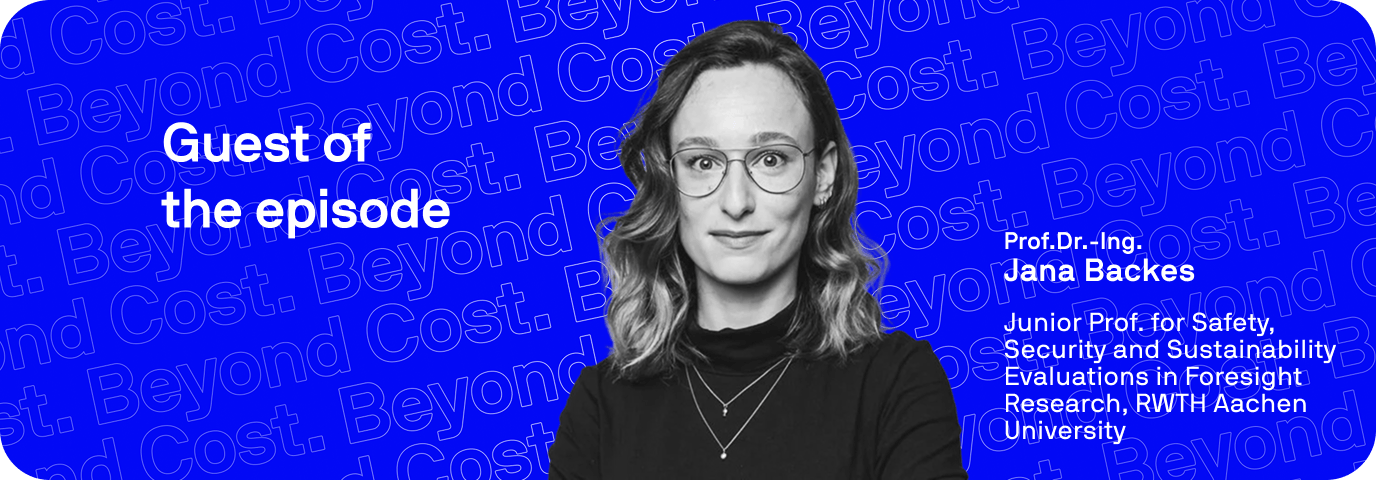
In this episode of Beyond Cost, host Jakob Etzel sits down with Prof.Dr.-Ing. Jana Backes, Junior Professor for Safety, Security and Sustainability Evaluations in Foresight Research at RWTH Aachen University, to unpack what cost engineers and procurement leaders actually need to know about carbon accounting.
From CBAM and emission costs already moving through European supply chains, to why CO2 was just the warm-up, to how AI is starting to help LCA practitioners manage the complexity of real value chain data, Jana explains why standardization, not certification, is the real fix.
In this conversation, you will learn:
-
Why two ISO-compliant carbon footprints can land 35% apart
-
How procurement should be pricing carbon into supply chain forecasts today
-
Why biodiversity is the next indicator to watch
-
Where AI helps in LCA, and where human judgment still wins



Read the full conversation below
Episode transcript
Jakob Etzel (Host): A warm welcome, this time from Aachen, to a new episode of Beyond Cost. My name is Jakob Etzel. I'm the Vice President Customer Success at Tset and the host of today's episode. It's a great pleasure for me to welcome Professor Dr. Jana Backes into this episode. We will speak today about sustainability, how sustainability is connected with product cost in a manufacturing setting. We will also speak about how you and your students are applying artificial intelligence when it comes to estimating sustainability indicators in a production scenario. But, Professor Backes, I think it's actually best if you take the floor and introduce yourself.
Dr. Jana Backes (Guest): Thank you very much, Jakob, great to be here, and thanks for the invitation. My name is Jana Backes. As said, I just got the chance to launch a new chair here at RWTH Aachen University called Sustainability and Foresight — in short, SaF. It's a junior professorship focusing on safety, security, sustainability, and foresight research. From my background, I'm an environmental engineer. I did my PhD here in Aachen and focused on life cycle sustainability assessment — the assessment of all three dimensions of sustainability. And if I'm not here and working, then I'm a mom of two young kids, really enjoying both sides of life — family life and being a mom, and on the other side, being a young scientist who really loves her position.
Jakob Etzel: That's great. Very impressive at that young age, already a professorship. And, as you said, your chair, usually that would be three different chairs, maybe one for sustainability, one for foresight studies, one for the security aspect. Very impressive how you try to combine all of this in your teaching and your academic research as well. Jana, you actually started your career in industry. You did a dual degree at BASF in the chemical industry, and then you went to Munich, studied full-time, and did your PhD here in Aachen at the very prestigious institution where you now have your professorship. But what held your path together? What got you where you are?
Jana Backes: I think the idea, or the interest, in processes in general, and then especially, of course, industrial processes. Back in school, I got the chance to participate in the youth science competition, Jugend Forscht cup, which brought me to BASF, accidentally let's say, because there was one of the competition parts, and I got to know BASF and was really impressed by that big company, all the processes behind it, and things like that. And then I decided that this might be interesting to start a career, and I started with the business program and studied business administration, which also today still is quite helpful to connect sustainability with economic aspects especially. BASF also at that time sent me for half a year to Chile, and I spent half a year in South America. I think that again pushed a bit the idea, or the interest, in sustainability in general, focusing on resources but also social sustainability, again coupled with cost because of coming out of the industry. And that led me then to my master's program in Munich in Sustainable Resource Management, which again covers all three dimensions of sustainability: the environmental, the economic, and the social dimension, bringing all that together. Sustainability is a practical dimension. We need it in the industry and also, of course, somehow in our daily lives. And that brought me also back to BASF, and then later on here to RWTH, focusing on the assessment of sustainability. But all driven by this interest in processes.
Jakob Etzel: Yes. And in recent podcast episodes we always asked what brought people into product costing. And the answer that came most often is it happened by accident. So you now said also by accident you got into your topic. But when you think back over the last 15 years, when was the first moment that you realized sustainability will be the topic of your life, and when was the moment that you realized you would end up in academia and not in consulting, where you had been, or in industry?
Jana Backes: I think that really might have been the time in Chile, where I came back to the idea that, okay, resources are important, social sustainability is important, things are interconnected. At that time I think it was clear that I wouldn't continue further with just the business aspect, but would add sustainability on top of those bachelor's studies. And then of course the master's program in Munich reinforced and supported that somehow. And during the master's program I also got a gut feeling that teaching is important to me, that education is quite important, that a lot of things can be brought to younger colleagues with enthusiasm, to also push the topics together and that we can learn from each other. Things would be best if we do them together, so teaching is quite important. And at that time, probably, was when I realized it might be academia, it might be teaching and supporting younger colleagues, which then also brought me back, after a year of working full time in industry, to academia to do my PhD. After the PhD, again, it was the question: will I stay, or will I go to industry and push things forward there? I think both is quite important. That's also what drives me to have a strong connection to industry, even though I'm in academia now, as it is a practical, applicative topic.
Jakob Etzel: The university in Aachen has a good history of being connected with--
Jana Backes: Exactly. And I personally also really like it because from industry we get a lot of feedback, which is quite helpful for research. And doing research just out of university in that specific topic of sustainability assessment wouldn't make sense, in my opinion. For that, the connection is quite important. And a lot of that, as you said, also from the other partners being in the interviews, a lot of that happened by accident, and with a gut feeling, and definitely also with an intrinsic motivation and the fun of working on specific topics, in teaching, in collaboration.
Jakob Etzel: And now speaking about the typical manager or executive in a manufacturing company, like the one that you have been working at, or the ones that you have consulted, what do you think is a common misconception they have about emissions and sustainability accounting?
Jana Backes: Misconception is maybe a bit too strong a word. I would say until a few years ago, sustainability was mainly connected to environmental or ecological aspects. Nevertheless, I would say nowadays it's getting better and better, and especially the big companies, I would say, all think already in more dimensions than just the environmental one. But of course it is easiest to connect it to, for example, a carbon footprint, because that's more accessible, data is more available than, for example, for social aspects. The economic dimension is always in mind when we talk from an industrial perspective. So the misconception maybe was that one-dimensional perspective, and maybe it still exists regarding how many sustainability indicators we are focusing on and using for decision-making. In best case, it should not only be the carbon footprint, but more. But there is a lot of movement driven by diverse aspects, which is quite positive, I would say.
Jakob Etzel: And if you think about your students, right now you are lecturing a series that is an introduction into sustainability for engineers here at the university in Aachen. When you think about your students who started two months ago in the lecture series, what has been their main misconception, or what is their aha moment in your lecture?
Jana Backes: So the one thing I already mentioned: that still the connection of sustainability is mainly driven by environmental and ecological aspects. And maybe also having a bit of the mindset that sustainability always needs to be green. So that sustainability is way more than just ecological or environmental parts. And on the other hand, also the aspect that I think we all should stay critical when we see numbers, because they imply there is just one value telling the truth. So if you, for example, think of a carbon footprint, then I think it's quite important to really tackle that number, question it, and reconsider whether it is plausible, how it was calculated, whether it makes sense or not, or also, for example, when we talk about net zero: might that really be the case? And if so, how did people arrive at that number? Or shouldn't it perhaps be a range instead of one final value? The main goal I have is that students start being critical regarding sustainability, being driven from diverse perspectives, and also questioning whether one value is really telling the truth.
Jakob Etzel: And when students leave your lecture series at the end of July, will they have done, as part of their homework, a product carbon footprint for a manufactured part?
Jana Backes: Yes, that will be one part. In best case, they are able to connect a lot of sustainability buzzwords, from global political aspects down to, for example, a carbon footprint, resources and emissions. And we also have a seminar connected to the lecture, where they get three main tasks, a bit connected to industry and also to concepts and perspectives. And one task there is also to calculate a product carbon footprint, but also, from the other side, to question whether that value is plausible, how it was calculated, and how many options one has, depending on how you model it, to get this or that result.
Jakob Etzel: So students will understand how to, let's say, fine-tune the PCF. But also, if they sit on the other side, how to validate it and--
Jana Backes: Exactly.
Jakob Etzel: Reverse engineer which fine-tuning might have happened. That directly brings us into one of the main topics of today's podcast, and I would like to connect it now a bit with cost. In a manufacturing process, emissions appear, it's part of producing something that I burn, for example, fuel, that I consume electricity. And already now the social cost of this environmental pollution is billed to companies, only partially, but it is happening. The main instrument for that is, we all know it, the Emission Trading System of the European Union. And you have made some analyses showing that already now cost is passed along in the supply chain. If I am a procurement executive, if I'm the head of purchasing in a manufacturing company, how should I deal with that?
Jana Backes: In best case, start integrating it into the balances and consider it for the entire value chain. So when purchasing, talk with the suppliers about whether they have already accounted for it. And if so, maybe also directly how they accounted for it, with which value, the actual one, and also updating it. Then, of course, for any forecasting, include it into the forecasts, and especially also include it, for example, if you think of new technologies or whatever developments might be there regarding new designs. Include it in the forecasting for new designs, also considering end of life.
Jakob Etzel: Good point. So let's dive one step deeper into the topics you just touched. You say forecasting, so obviously as a head of procurement, I want to understand how much I will spend, how much money I will have to pay for the goods that I need to purchase next year for company operations, but I also need to forecast maybe five years out. So what you say is that costs might increase due to changed emission prices, but also due to changed legislation, correct?
Jana Backes: Yes. And I would also say due to geopolitical aspects, and probably also economic aspects. To be honest, that's definitely not my main research area, and I would place that more in the areas of colleagues from the economic or political areas, things like that. But there are a lot of aspects coming together. In my research area, when it comes to sustainability assessment, we have to consider it because it factors in, be it in euros, dollars, whatever. But also, of course, in emissions, and we have to account for it as well, especially when it comes to new designs and forecasting. So when we come again to that foresight research, for example, it is important to have that in mind. But I would say we are not the right people to ask when it comes to what might be the value in euros for a ton of CO2 in 10 years.
Jakob Etzel: But I might just call my head of strategy at work and ask the strategy department, "Give me a price" with which I should calculate. But then the question is, okay, I have now the price, but on which input factor should I multiply it? How would you say should I approach making a baseline of my supply chain product carbon footprint? So if I am new as a head of purchasing in a manufacturing company and I realize my new workplace has no idea at all what is the product carbon footprint of all the purchased goods, what would be a good starting point? How can I get the first number, which I can then use to calculate some forecasts?
Jana Backes: I would say most important is to understand the processes and the manufacturing which is behind. And of course, I would also say that almost every company might or probably has already all the data needed, because they purchase goods anyway. They know how they process. So they all have their scope one, two, three data. They know what energy they purchase and so on and so forth. And I think it's quite important for everybody to understand that flowchart, so you know how the product you want to have at the very end is processed, what resources you need for that. And then you can also draw the entire value chain. In best case, you get down to the first supplier in the entire process, which is probably the hardest part. That's also the main issue we have in sustainability assessment. It's about data, and often we, at a company, can get the data from the first supplier one step back, but maybe not the entire value chain downstream. And that's the biggest issue, probably also for the companies, to understand the entire value chain. In parts, it might then be necessary to make assumptions. In other parts, I think it's getting more and more important to be transparent with the value chain, to understand the entire back-tracing.
Jakob Etzel: So you would say I would pick some of the most expensive goods within my spend, and then try to understand which energy sources, like natural gas, electricity, go in there. What are the main processes, where they are consumed, and then obviously where they are located, in which geography.
Jana Backes: Yes. And whether they, for example, consider critical resources.
Jakob Etzel: Raw materials, yes.
Jana Backes: Exactly.
Jakob Etzel: And you say critical resources, you mentioned that just because of the product carbon footprint, or also because of other aspects of sustainability?
Jana Backes: Also for other aspects. On the one hand, if you stay in that environmental area, then of course due to emissions a product carbon footprint, so CO2 emissions, or CO2 equivalents, but also, of course, resource criticality. So how much of a specific good can we still extract, or should we maybe better think of circularity aspects and make use of a secondary life of a specific resource? And when we have that, of course it is all again connected to costs, but also to a social dimension. So if you talk about mining in other countries of the world, how are working conditions, how is the entire supply chain from the mining where we get the raw resource, up to a final product we might see here?
Jakob Etzel: So the first thing is getting transparency: where are the goods coming from, who is processing them, what are the critical production processes and raw materials involved. And then you say I will use this for PCF calculation, but I will also use this information for a lot of other indicators that I might want to create as part of the sustainability efforts. And now I would also like to discuss another point that you mentioned. You said in a procurement executive position, someone looks forward to what new technologies and new materials might be purchased in one year, in three years, in five years. And you say already there it's important to assess what the sustainability aspects are. Do you have any particular new technology or material in mind that you've also touched on in your research?
Jana Backes: Not really, to be honest. For us it's more about the methodological perspective: how can we assess and how can we also support decision-making regarding, for example, new technologies or new product designs, and so on and so forth. To support them in making sustainable decisions and also to show potential trade-offs between sustainability aspects, to help decide what is more important. Is it really the emissions? Is it the cost? Is it the social value chain? And so forth. I think it's better to talk with those people who are more in depth on that.
Jakob Etzel: You argue, in your public appearances and in your papers, that one should not reduce sustainability topics just to the product carbon footprint. Also in your introductory words today, you said it's much more than that. But why do you think industry is still so much focused on the CO2 footprint?
Jana Backes: Because it was mainly the important part being covered in media, and also being requested somehow. And on the other hand, because there the data availability is probably the best one existing, just because it has been in focus for years already. I think most big companies already make use of software solutions, databases, and things like that, where the CO2 itself, but also all the other emissions contributing to a carbon footprint, are probably best measured and considered. And due to that, the data availability is best and most accessible. But maybe to add to that, also because reporting requires it. So a carbon footprint is required by sustainability reporting, and also somehow by everybody outside asking how sustainable you are, and then people connect it with a carbon footprint. That's probably the reason why this is mainly focused on, still, even though people know quite well about the other sustainability aspects.
Jakob Etzel: But would you say it's fair that PCF got the most attention in the beginning? Is this really the most pressing problem, and therefore it's good that it's being addressed first? Or do you say some other topics that right now are more or less overlooked would have way higher importance and priority?
Jana Backes: Well, years ago we talked about ozone, which was quite an important sustainability aspect. That is now, let's say, solved, or at least we are on the right track. And now it's global warming, or climate change, however you want to call it. And here it's definitely clear that CO2 equivalents are relevant, and I think also in different countries of the world we might experience, even more than we already have here in Germany, that climate change is real. So that indicator makes sense. But it could also be that if we make a turn and move toward reduction, in 20 years it's no longer product carbon footprint, and we have a different topic. For example, biodiversity as an indicator is getting more and more important and people are paying more attention to it than they were years before.
Jakob Etzel: So you say ozone took more than just two years to get solved, it took a couple of decades.
Jana Backes: Exactly.
Jakob Etzel: But humankind showed that they can indeed solve sustainability problems. We are focused on PCF now, and then you mentioned biodiversity. And you are not the first one. I recently asked someone, "Am I missing out on a topic? What will be next?" And biodiversity came up. So will it be the next big topic? Can manufacturing companies already expect that they need to write long biodiversity reports in the next five years?
Jana Backes: To be honest, I don't know. But at least I would say there is more attention on it than there has been. So it might be easy to forecast that there will be more. And also from the sustainability assessment perspective, more attention is being paid to it. So maybe it's becoming a second quite relevant indicator in future, besides the carbon footprint.
Jakob Etzel: Is academic output globally increasing in the field of biodiversity?
Jana Backes: I would say yes. I myself haven't paid that much attention to it until now, but from colleagues in other institutes and universities I get the information that this is increasing and becoming more and more important. So maybe, I don't know, sustainability reporting in future would also need that indicator to be reported, and CO2 is getting less focus. Let's see what happens in a few years. But definitely that topic is increasing.
Jakob Etzel: Yes, very interesting. I would now like to talk with you about the core of your research, because so far we've rather touched neighboring topics. The core of your research is methodology, how exactly do I measure things, for example the PCF. In one of your research papers, you made an example that a steel coil in the calculation can end up with very different numbers, it can be up to 35% different. What are the main reasons why the same physical piece of material in the PCF analysis ends up with such different numbers?
Jana Backes: I think we have to touch on a few different layers there. So if we take it just from the production perspective, then it depends a lot on what kind of resources were taken from where, which energy sources were considered, and of course also in which country the production happens, and how the production itself really happens. That might be one layer, because we all know that if you, for example, include more scrap into a system, then emissions and also resources might be better than if you take only primary material. And for example, if you consider green energy, whether solar, wind energy, whatever, then of course also a carbon footprint decreases due to green energy. And if you, for example, produce in Norway having only green energy compared to other countries, then here again there is a benefit in the emissions.
Jakob Etzel: I think that's the part very easy to understand for everyone with a technical engineering mind.
Jana Backes: Yes. And I would also say that production engineers in a steel company could explain it even better than I do. I have some understanding of the processes. And then when we come to the area where I'm mainly working in, into that assessment itself, and for example, if we stay with the product carbon footprint, then we talk about life cycle assessment, which is the methodology being used. And here, there is a diversity of things which might lead to that range of different carbon footprints for, for example, a steel coil. And for that, I think it's important to understand that there is already an existing ISO norm that has been in place for years, which guides everybody through the entire LCA process. Is this 14064--
Jakob Etzel: Four, or something in the 14--
Jana Backes: Exactly. The LCA norm family, the LCA itself is 14040 and 14044, and then for the product carbon footprint, 14064 and 14067. So there's guidance, and one would think that this is totally clear and we can all end up with one final value that is the same. And that's where the full truth isn't there, because there is variation in the system, which from a scientific perspective is quite important and interesting. But for comparison reasons, and maybe also for everybody outside the LCA bubble, it's quite hard to understand why a steel coil has so many different values, except with the knowledge that it comes down to resources and energy, for example.
Jakob Etzel: So let's assume I keep the material source fixed, I keep the energy source fixed, I keep the location fixed and the process fixed, and I need to make a PCF that in the end the validator will assert is following the ISO norms. What can I change to get it a bit higher and to get it a bit lower?
Jana Backes: If I dive into the LCA, one of the main aspects is data. So am I using primary data out of my fixed variables in the production, and am I taking the measured values? Then a lot is already solved. If I'm making use of secondary data out of databases, which in LCA is often done because primary data is missing, then we often make use of databases, open access but also paid. There is data in the background which is not perfectly fitting to exactly that process I have. And I often also have a variety of potential processes I can select to model. It might be that if you do an LCA and I do an LCA, and we didn't talk about it, and we both found a process which said "heating," for example, each of us might have taken a different one, even though both were named "heating," and both brought different background knowledge and background data. And we came up with a slightly different value just for heating, which of course also changes the final carbon footprint of my steel coil.
Jakob Etzel: So I can create a PCF that is compliant with the ISO norm while using secondary data.
Jana Backes: Yes. And there, using a variety of secondary data, or maybe also primary data, bringing different data backgrounds, leading to a change in my final value. That is one point. Another point which brings diversity in that final value is the impact assessment methodology. That means how individual emissions contribute to, for example, a carbon footprint, or a CO2 equivalent, let's call it that, because it's not only CO2, it's also methane, for example.
Jakob Etzel: So there are, how many, 16 greenhouse gases or a bit more or a bit less? Is that number actually fixed, what classifies as a greenhouse gas?
Jana Backes: Which chemical components contribute to the carbon footprint depends a bit on which methodology I choose.
Jakob Etzel: So also that is not fixed.
Jana Backes: Exactly. And then how much weight, for example, methane carries compared to CO2 also varies a bit from methodology to methodology. And there is a variety of methodologies out there. In LCA research, I would say there is a tendency toward one or three different methodologies which are often used. And also in industry, I would say the different sectors make use of more or less a specific assessment methodology. Nevertheless, it's not always the same. And with that, comparison gets difficult, because if you use one methodology and I use another, then we definitely won't have the exact same value, even if we choose the same data, just because of the different weighting.
Jakob Etzel: So the question of whether I use primary or secondary data, and if secondary, which one I choose, is one factor of variation. Then the impact assessment, like which greenhouse gases are included and which not, and how they are put into equivalence.
Jana Backes: Exactly.
Jakob Etzel: Any other lever that I have in the methodology?
Jana Backes: Yes. In the goal and scope, which is the first part of an LCA, I could decide how I draw my system boundaries. So am I focusing, for example, from cradle to gate, taking all the resource extraction, including transport, all the processes and manufacturing, which might be at my company, but also already at suppliers beforehand, into the process? Am I only considering, for example, gate to gate, so from there it only considers the production I have internally, mainly focusing on, for example, energy used to process? Am I also considering a use phase, for example? Am I already accounting for an end-of-life option in the model, and so on and so forth? So also this, of course, results in a diversity of values, because it's clear the broader we take the system boundaries, the higher the value probably will be, except if we take the end of life in, and end of life might also come with recycling. And then it might end up as a credit, balancing out again. That could be an option.
Jakob Etzel: But would that mean that if I'm producing something that emits some very exotic greenhouse gas in a very large amount, I might then look at the three or four most commonly used LCA methods and pick the one that weights this gas the least? Whereas if I'm more a standard manufacturing company where most of the problem is carbon emission, I might rather pick another methodology. Is that really happening? Are companies already exploiting the variance of methodologies? Because for all of them I can get in the end a certificate that says the auditor confirmed it's compliant with the ISO norm.
Jana Backes: Yes, exactly, that would all be compliant with the ISO norm. Thank God it's not as concerning as you described. The emitted chemical substances are not that diverse across the impact assessments. Nevertheless, the weighting does change a bit. I would say this is probably not the biggest reason for variance in the final carbon footprint, but it does count. Even more important is probably the data part, the second phase of the LCA when it comes to choosing data, for example, from databases. And then, of course, if I'm able to choose from a variety, staying with that heating example, to take a value which is lower than another one, and I could take it because its description indicates it's doing what I'm doing in my processes, using energy for heating, but it has a lower emission for that process than another one, of course, with that I would be able to reduce my carbon footprint. And it is ISO compliant because there is no rule that says you always have to take the highest value. Nevertheless, I would also say it's important to note that according to the ISO norms, values get checked by external reviewers. That is a must when using the data for any published aspect. And I also think, or hope, that all LCA colleagues are quite critical in also focusing on which data was used and why you chose that value and not another one. Could you please explain? And with that, I hope that the values are clearly explained and reasonable. Nevertheless, if I know quite well what to choose and that there is a variety, I'm able to choose in whatever direction. In best case, and what is mainly done in research, is that we consider the worst value, the most conservative example being used for a value. And with that, we can more or less say it probably won't be higher than that value, because we took the worst numbers.
Jakob Etzel: Fair point. In research you are interested in the worst value, but as an industry player, one might go the other route.
Jana Backes: Yeah.
Jakob Etzel: Very interesting. Going back to the example of the steel coil where we started this discussion, could it happen that the auditor validating my product carbon footprint says the main energy precursor is electricity? Let's assume we are not going the blast furnace route but the electric arc route. And I use secondary data, for example, for a steel mill in China, just an International Energy Agency value, two years old, average Asia electricity footprint. Could it be that the validating agency says, "We reject that. You need to improve. You need to call your utility company and provide a written document about what the actual emissions are."?
Jana Backes: Yes, it could happen, and I also hope that this happens, to be honest. The ISO norm already states that the data should be timely valid, so no old data, and that it should be geographically fitting. For example, if we are producing steel here in Europe or in Germany, then the Asian value hopefully would be directly rejected with the reason: how can you take Asian electricity values into a German production, for example? That doesn't make sense.
Jakob Etzel: And, connecting it again with cost, from a manufacturing company perspective, I would take this value and multiply it with cost, for example, to make a forecast of how much in my supply chain the cost for the Emission Trading System in Europe, or an equivalent instrument abroad, will increase. And then in this forecast, I can take a more conservative value to be on the safe side, or in the methodology I can take a more favorable one in the sense that I get a lower cost increase. But here comes my question: when the European Union calculates how many emission certificates I need to render, are they giving a clear methodological guideline? Or is the European Union saying, for a steel mill, just calculate something that is certified under this ISO norm and that's good enough, and based on that you hand over the certificates?
Jana Backes: To be honest, I would need to recheck that in detail. But there are already existing approaches like, for example, the EPD, Environmental Product Declaration, which is a bit more structured and detailed than the ISO norm is. It is fully based on the ISO norm, but it already says we take these indicators and they have to be weighted in a specific way, so in the inventory phase, when it comes to which chemical reactions are weighted regarding the CO2, this is already fixed. Or, for example, also PEF, Product Environmental Footprint. They guide already in a more standardized and comparable way than if you just leave it to the ISO norm, because there the freedom exists. And if I'm not mistaken, I think there is a guidance or requirement from ETS saying this and that methodology should be used, but I'm not sure how strict it is that it needs to be used.
Jakob Etzel: But this is very interesting what you say. Without checking the details now, you say yes, there is a movement of political actors to not just accept the ISO norm, which allows for a lot of variance, but already to give clearer guidelines. But it might also mean that other political actors in Asia, in North America and South America, might actually specify it in another way, and I'm again getting a variety of different norms.
Jana Backes: Nevertheless, I think somehow we are currently the frontrunner here with the European Union. And due to the fact that we also have CBAM, the Carbon Border Adjustment Mechanism, which is the external pricing coming into Europe, connected to the ETS, that somehow also requires the same rules. And with that, I would suggest that non-European countries might take over the rules from Europe as the frontrunner, because it is required here. And with that, if they would come up with something different, it is hard for the entire supply chain to adopt it, because it differs again. And then it's also hard to integrate materials, resources, and products into the European context, because then comparison and also the CO2 pricing might become even more complex.
Jakob Etzel: I see. So you say with the CBAM, with this part of the greenhouse gas pricing of the European Union that is tackling external actors outside of our borders, with this regulation, we have already started exporting our definitions. And it's very likely that others will take over. So there is some momentum which will also streamline the methodology.
Jana Backes: I would expect that, yes.
Jakob Etzel: I would have many more questions on this methodology topic, but I would like now to jump to some maybe more practical issues and less theory. So what we see is that in industry, the most widely used tool for LCA, life cycle assessment calculations, is still Microsoft Excel. Would you agree? Or is it actually different? And would you say that making it in Excel is a problem? I know from the banking field, sometimes they treat important calculations done in Excel as a systemic risk for failure in their company. Is there something similar in the sustainability area if too much is done in Excel?
Jana Backes: Regarding your first question, whether it's mainly used or not, I would say it depends a lot. The big companies, I would say, mainly make use of existing software solutions, in best case already somehow connected to, for example, a bill of materials, so to other ERP systems, or at least starting to connect that and building up individual solutions. So here I would say it's no longer Excel-based, mainly because of such a large product portfolio that with Excel sheets it would probably get too complicated, and we would come to exactly what you said from the banking area: the defaults in the assessments would probably increase. Nevertheless, Excel can be a good solution, especially for getting started with such a system, for smaller companies, just because software solutions are quite expensive. And then this is a good way to begin somewhere. But as soon as your product portfolio increases, or the number of assessments you have to do increases, Excel might get a bit difficult. I think one can build up a really good product carbon footprint assessment in Excel. It's just a multiplication, so it's not really rocket science. And you can also include database values in an Excel sheet, that's also no issue. But it might be easier to introduce additional errors into the system just by missing cell connections. It's also not so easy to understand, for example, a process flowchart, which can be built in different software solutions. The visibility is easier to understand there, and it's also maybe easier and faster to change aspects in that flowchart than in Excel. But it is for sure being used, and it can definitely be a very good starting point. And in the long run, taking a professional tool that is tailored for exactly that could be easier.
Jakob Etzel: Yes. You mentioned getting in the bill of material. This is obviously the dream of everyone, having some piece of software that I just push the bill of material into, and it spits out the product carbon footprint, ideally already with a verified ISO norm label. How far away are we from that? And I understand there is also some research going on in your research group on that.
Jana Backes: I think we are already there, at least partially. I don't know how good it is, but there are, I would say, a bunch of startups out there working on that, and also universities. So from different areas, there is work being done on that. How good these solutions are, I don't know, because I haven't tested them, but at least there is a lot ongoing, and I also hope that sooner rather than later there will be a good solution, or maybe even more good solutions, to be used and integrated into existing software and company structures. In research, there's also a lot ongoing. What we have done until now is working with large language models, which brings me back again to that data selection part. So if we know our process, and we were at the point where we talked about somebody purchasing materials, we know the entire process which happens at our company, then we are able to also build that into emission systems. And with that, we understand that value chain. And then it comes to the selection of which values of carbon emissions we put behind it to get the PCF. And that connection from the real process into emission data could be simplified, and maybe also be less subjective, when making use of AI or large language models, however we name that. So there is ongoing research, ongoing practice, and maybe the startups are even faster than we are. Could be. On the other hand, maybe research has more depth in it. And I think connecting both worlds probably brings the best solution. But I think that sooner rather than later there will be good solutions which solve that issue of having a bill of material directly translated into a carbon footprint.
Jakob Etzel: So you are using AI here at your chair in research efforts, if I summarized that correctly, to match information in the bill of material or in other documents with databases.
Jana Backes: Yes.
Jakob Etzel: And for me it was very interesting that you used the word "objective." So would you say that if a human person is doing that matching, they would not be as good, or would be inefficient compared with an automated large language model? Is the main target of this research just to increase efficiency, or do you actually think an LLM model is also less prone to certain biases that a human mapper would have?
Jana Backes: It's both, definitely. I think I need to be a bit careful with the definition, I think it's more machine learning than really AI, what we do. So it's more language training. But on the one end, the system is faster than if a person has to go through, for example, a long bill of material. Especially, for example, if you think of a steel production and we take it cradle to gate, so from resource extraction until the steel coil is ready, it's a huge process. And if you have to consider all the individual raw materials, energy streams, transport, and so on and so forth, it takes a while until you have that large bill of material, or multiple bills of materials, built into, for example, a software solution to end up in a carbon footprint. If a large language model could already start connecting the real resources to a database, it is faster on the one hand, and it might be more objective than a person doing that, because if we all use the same large language model, then the subjectivity of individuals doing that assessment is gone. Nevertheless, it always needs an expert checking through whether the data selected by a model is really answering the questions we have. So is it really that material, really that energy which exists in reality, and is it really reflecting the processes I'm doing?
Jakob Etzel: You say that now, but maybe in five years the AI is better than the human being.
Jana Backes: Hopefully, yes.
Jakob Etzel: And do you also see other fields of application for artificial intelligence, or whatever it is, LLMs, machine learning, in the field of sustainability?
Jana Backes: Yes, I think what would be quite interesting is optimization or forecasting. Often now when we do an LCA, it's status quo, and then we assess what is already there. But for example, as I said earlier, when we talk about sustainable designs, new products, new technologies, it might be quite interesting to come up with a bunch of scenarios. Sometimes we do it now, for example, to see what would happen if we change a parameter, whether it then gets better or worse than the status quo. But it's not really a prediction of future scenarios. And for that, I think it might be quite interesting to get optimization and also forecasting into AI models, which I'm really not an expert on, but hopefully people in my group can support in that. With that, showing: if we decide today to do this and that, then the following scenarios might happen in future, and that would result in the following product carbon footprints, having the following costs, and also the social value chain, with that you're able to decide for your optimal solution. Which probably will never be an optimal solution for all three pillars.
Jakob Etzel: Okay. But optimization between different sustainability KPIs--
Jana Backes: Yes, and also coming up with a variety of scenarios, which might be quite time-intensive if a person has to do it.
Jakob Etzel: And you said you're not an expert on AI, but still you use it. Your expertise is in the methodological topics. But, we talked a bit before the podcast, you said you are now getting a computer scientist into your research team.
Jana Backes: Yes.
Jakob Etzel: So even if it's not your expertise, you still bring in the topic proactively. You have the expertise within your students, within your researchers, and you are also investing in the applications of AI here. Speaking about the students, you are launching a new industrial sustainability module in the master's program in the current semester, correct? That's the lecture you're giving, and it's a new one, it did not exist before.
Jana Backes: No.
Jakob Etzel: What should the next generation of engineers, for example, alumni of RWTH Aachen, be able to do that the current generation of engineers who are now in working life were never taught?
Jana Backes: I would say integrating all three pillars of sustainability, environmental, economic, and social. And then also understanding the trade-offs between the three. Maybe adding a technical perspective as a fourth one, so that also, for example, a long lifetime, good quality, and things like that are integrated. So thinking always out of at least three dimensions when it comes to processes, new products, and things like that. And then, on the other hand, critically questioning the values being published. That's definitely one, maybe the most important, goal I have for my students: that they are truly able to critically think about values being published, really critically think about what sustainability means, and then also challenge numbers, but also the different dimensions. So why did somebody decide to take, for example, a product which has low emissions but, for example, high costs and not the best social value chain? Question that. Is it the best option? And if so, why? Or might another option with high emissions and low costs be better because of whatever reason? So critical thinking and reflection of sustainability in general, that would be the aspect the next generation always needs to consider in every process, every decision-making, and so on.
Jakob Etzel: And when your current students in 10 years are in important positions in industry and are the decision-makers, what do you think needs to have changed by then in sustainability assessment in your sphere of expertise, so that numbers are finally comparable and truly decision-relevant?
Jana Backes: The key word is standardization. Especially from the industrial and application perspective. For research, we might have a different opinion, but for industry and comparison reasons, it's standardization. We just talked about assessing a product carbon footprint. There are variables where it can change, and that's why, for example, a company can have quite different product carbon footprints. Where is that coming from? These variables, it might make sense to fix them, so that comparability increases. And with that, we have standardization, in best case cross-sectoral. And with that, we also get a comparison of values, be it the carbon footprint, but also other values, which makes a value chain easier to understand and also products and processes way more comparable, which again feeds into technical expertise, improved processes, and so on.
Jakob Etzel: To conclude our podcast, I will have a rapid fire section now for you. Three questions, very quick answers, just one or two sentences. Let's get started. Jana, one regulation you would simplify right tomorrow?
Jana Backes: Standardization for product carbon footprint.
Jakob Etzel: What do you think is the most underestimated data error in sustainability accounting?
Jana Backes: Primary data from companies which is not open access.
Jakob Etzel: And what is the first thing that a CFO, a Chief Financial Officer, in a manufacturing company should do this week to take emission costs seriously?
Jana Backes: Implement it in every accounting you have internally, for every forecast.
Jakob Etzel: Thanks a lot, Professor Dr. Jana Backes, junior professor for safety, security, and sustainability evaluations and foresight research here at RWTH Aachen. Thanks a lot for the great conversation.
Jana Backes: Thank you as well.
Explore the episode highlights
BLOG
The Hidden Variability of a Carbon Footprint
Read the highlights from the Beyond Cost Episode 7 with Dr.Prof.-Ing. Jana Backes, as she explains the hidden variability behind carbon footprints, the limits of LCA methodology, and what manufacturing leaders should do about emission costs today.