Ask a room of cost and value engineers who uses AI every day, and almost everyone stands up. Ask who uses it every day at work, and the room stands up again. Ask who trusts AI fully, and the picture changes: "Everyone is using AI heavily. However, none of us are really trusting it fully."
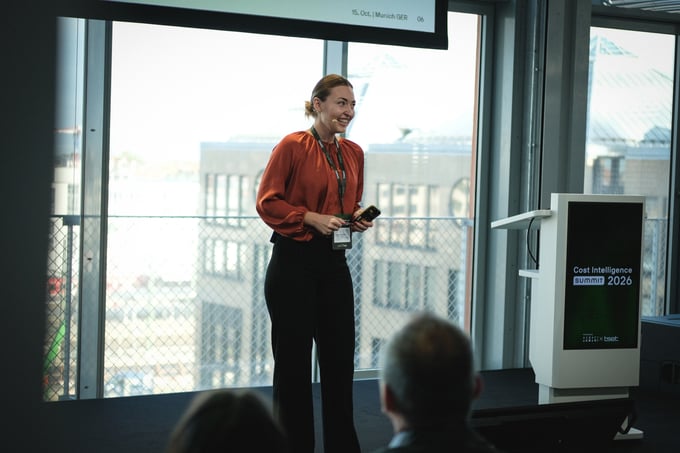
Aksana Svirydava, Global Program Manager VAVE & AI Solutions at Knorr-Bremse Rail, ran this live poll at the start of her talk at the Cost Intelligence Summit 2026. Wider data shows the same gap: a 2025 global study by the University of Melbourne and KPMG found that 66% of people use AI regularly, but only 46% are willing to trust it. Her talk showed what makes AI in value engineering work: clean data first, agents second, and engineers who develop the ideas with the tool themselves.
Start With the Data
Aksana Svirydava's roadmap moves from data availability through process automation and pattern recognition to workflow orchestration with AI agents. The order follows her main point: AI in value engineering is only as good as the data beneath it.
At Knorr-Bremse Rail, part data sat in SAP, in Windchill, on SharePoint, and in Excel files some engineer has worked with for 20 years. It is the same master data problem most cost engineering teams know.
So the team built its own database first. A flow in Azure combines deterministic automation with AI-based optical character recognition (OCR), reads 10,000 drawings or more overnight, and stores material, weight, size, surface data, and norms for each part. The team uses off-the-shelf models and picks the cheapest reliable one: GPT-5 mini for basic data, stronger models for precise data.
What Clean Data Makes Possible
With the drawing data in one place, the team connected it to ERP prices and quantities. The result is one record per part for more than 100,000 part numbers, shown in a Power BI dashboard. Buyers now find price discrepancies themselves, such as an extruded beam of one meter that costs less than the same beam at half a meter.
The same data feeds two tools that need no generative AI. An automated workflow combines drawing and CAD data into a cost estimate for each component, so every proposed part change in a VAVE or design-to-cost workshop gets a quick number that a cost engineer then checks. A machine learning algorithm compares parts and finds duplicates, such as identical screws bought under four part numbers at different prices. Similar part search like this is one of the AI applications that change product cost analysis the most.
AI Agents for Value Engineering: Optimind and What Comes Next
With transparent data and fast cost estimates in place, the team took on the step that costs the most time in value engineering: finding the ideas. This is where AI in value engineering gets creative. Design-to-cost workshops cost Knorr-Bremse Rail a lot of travel and effort, so Aksana Svirydava built Optimind. It reads a drawing, finds the cost drivers, and proposes 15 or more technical ideas in about one minute.
She taught it the processes and the methods a human team uses: TRIZ, DFMA (Design for Manufacture and Assembly), and SCAMPER. In her view, most creativity is pattern recognition: knowing which questions to ask, such as whether you can reduce the number of parts. Engineers develop the ideas further with it. In Knorr-Bremse Rail's tests, this way of using AI in value engineering gave a reliable idea after about two hours.
Five of six levers are live. The sixth, the next stage of AI in value engineering at Knorr-Bremse Rail, is not built yet: a multi-agent system for the full VAVE workflow. An orchestrator coordinates agents that:
- Collect information: pull data from systems and drawings and define the focus parts.
- Evaluate gaps: find the discrepancies.
- Generate ideas: Optimind finds technical optimization potential.
- Estimate cost impact: calculate what each idea saves.
- Plan implementation: define tests, time, and investment.
A human stays in the loop at every step.
Why Nobody Used the AI Tool at First
The created tool Optimind saved time and was easy to use. However, almost nobody used it. For AI in value engineering, adoption is the hidden part of the work, and Aksana Svirydava found three reasons:
- Lack of trust: the result of her opening poll. Engineers with little time do not try a tool they do not trust.
- A threat to their own role: a tool that proposes in minutes what took an engineer hours feels like competition.
- No workflow fit: Optimind sat in the Copilot environment, outside the development process, so using it was optional.
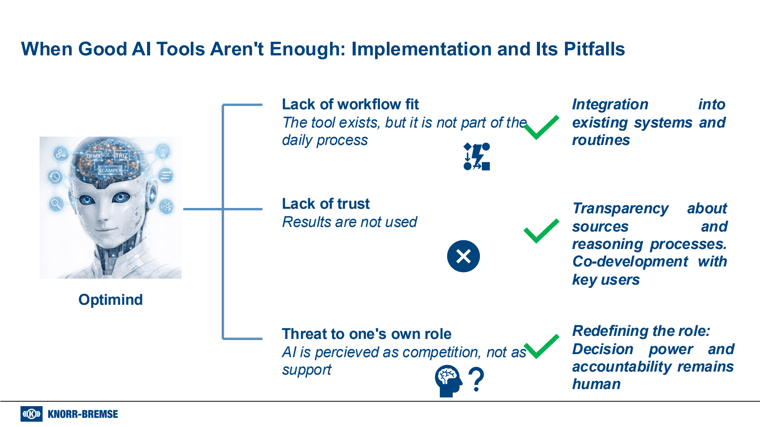
Her answers: build the tool into existing routines, show the sources and reasoning, develop it with key users, and keep decisions with people. About 80% of the rollout time went into acceptance; building Optimind full time takes about three weeks. What finally made this AI in value engineering tool stick was the workshop format: engineers used Optimind themselves, so they accepted every idea they chose to pursue.
What AI in Value Engineering Means for Your Team
Aksana Svirydava expects AI to change the role of cost and value engineers, and not to replace them soon, also because the data is not ready. The work moves from creating ideas and calculations to checking them and taking accountability, the same expert review that AI in cost engineering needs.
Her final advice to teams that have not started with AI in value engineering yet: "It's always worth starting and seeing where it takes you."