About the episode
A client hands over a spreadsheet with 200 cost reduction ideas, collected over five years. Nobody can explain half of them. None of them has an owner. Benjamin Knobloch sees this in every second cost reduction program he starts.
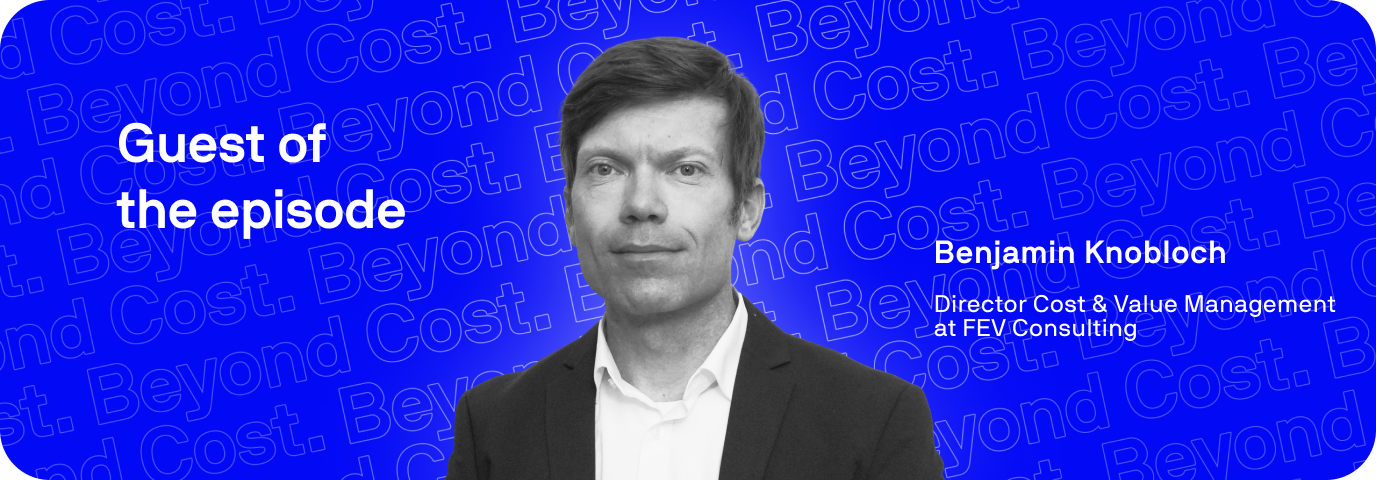
In this episode of Beyond Cost, host Jakob Etzel talks with Benjamin Knobloch, Director of Cost and Value Management at FEV Consulting, about why cost reduction stalls after the workshop. Benjamin built FEV’s cost engineering practice from a one-person team 18 years ago. Since then, he has run should-cost, benchmarking, and target costing projects in automotive, marine, agriculture, construction equipment, others, most recently on a humanoid robot.
Benjamin Knobloch sees the same thing in most cost engineering teams. The people are good and the goal is clear. But their week goes to 15 standing meetings and to design updates sent as CAD screenshots in PowerPoint. AI on top of that only makes the same process run faster.
In this episode, you will learn:
-
Why most cost reduction ideas never reach implementation, and what it takes to move an idea from brainstorm to savings
-
Where cost engineers lose their time, and why the first step for a new head of cost engineering is to make that time visible before buying new tools
-
Why companies will spend millions on AI and still miss their targets if the processes behind it stay the same
-
What changes when cost engineering focuses on customer value and profitability, not only on cost
Most companies already have the cost reduction ideas they need. The real question is who will own them and see them through.



Read the full conversation below
Episode transcript
Jakob Etzel (Host): Welcome back to our podcast, Beyond Cost. I am Jakob Etzel, Vice President Customer Success here at Tset, and I will be your host for today's episode. Today's guest is Benjamin Knobloch, Director of Cost and Value Management at FEV Consulting. In this episode, we will talk all about cost engineering: how it can unlock new potential, how it really should work, and what you see in the industry. Benjamin, it's so great to have you here today, and thanks for joining.
Benjamin Knobloch (Guest): Jakob, first of all, thank you very much for inviting me to Vienna. It's a pleasure to be here. My name is Benjamin Knobloch. I'm Director at FEV Consulting. FEV Consulting is a management consultancy positioned between strategy and technology, as part of the large FEV Group, which is mainly an engineering service provider with more than 5,000 people. I'm responsible for advanced robotics and also for cost and value management, which is maybe the core topic for today. I started there 18 years ago and built up what, at that time, we called cost engineering as a service, from scratch. Today we call it cost and value management. I work for many different customers in various industries. Automotive was always a core business, but also marine, agriculture, and construction equipment. So many products that have something to do with propulsion systems or mobility concepts, but also other things I would call highly engineered products, like electric screwdrivers and air compressors. I'm also very proud that we recently started our first cost benchmark of a humanoid robot. And that's what I like about the field of cost engineering, cost and value management. You are always working with the latest product technology and production technology, typically in a very cross-functional way with different departments, engineering, different stakeholders, and different stages of product maturity. That's what I really like, and that's my day-to-day business.
Jakob Etzel: Thank you, Benjamin, for the introduction. I guess you get around a lot. So what does a typical day or a typical work week look like for you?
Benjamin Knobloch: There is no typical work week, because it is so varied. We have so many different clients from different cultures, and we do so many different things, like target costing in early phases. We do cost benchmarking, and we help customers improve profitability, in terms of cost reduction but also value improvement. It's so varied, there's actually no typical day.
Jakob Etzel: And I understood, correct me if I'm wrong, from the industries you mentioned, that you're not only working with high-volume products, say 100,000 pieces produced a year, or typically one million in the higher-volume automotive business, but also with products that have a bit less volume, right?
Benjamin Knobloch: That's exactly right. When we're working in the automotive industry, you may have production volumes of 500,000 or a million a year. But then we have other industries, like agriculture, or other commercial applications. There it could be 30,000 or 10,000. I've also worked on sports cars, where the production volume was only 1,000 a year. So you have very different challenges coming from that production volume: what the right manufacturing processes are, how to judge what the profit for a supplier is, and also, in terms of cost reduction, where the right levers are. It's very different.
Jakob Etzel: You've worked with so many different products and industries, and that's only possible because you, Benjamin, have been in cost engineering for nearly 20 years already, right? If I got it right, you actually built up FEV's cost and value management practice more or less from scratch 18 years ago, essentially starting as a one-person practice. I'd be interested in what it actually took to turn that into something companies are willing to pay for. Did it work from the beginning, or was it more of an evolution?
Benjamin Knobloch: It was an evolution, but actually the start was not that hard. This was a time, around 20 years ago, when cost was maybe not such a core KPI in many development projects, also depending on the region, and at least not at the level of the engineers. But at that time, more and more companies were realizing it's not sufficient to develop and produce great products from a technical point of view. You also need to develop products that are commercially attractive and competitive. When I started 18 years ago, I was mainly working on what I would call target cost projects or cost forecast projects. I was involved in large development programs, mainly in combustion engines at that time, which maybe proves that I'm old. The task was to make cost transparent, to make cost estimations and cost calculations for all the different components. It was already very cross-functional at that time. I was deeply involved in the engineering processes, talking to the designers every week. I think when you make cost transparent, it's quite obvious that you find cost drivers. And when you see cost drivers, you also find opportunities and countermeasures to reduce cost. And when you can demonstrate that your work saves cost, it's quite obvious what the value of that work is. So it was rather easy to start that as a business. I started as a one-man show, but then the team grew, and today we have a global setup with teams in the US, Europe, China, and India.
Jakob Etzel: And I guess you started with an Excel sheet.
Benjamin Knobloch: Yes and no. In the beginning, I started with Excel, that's right. But I was looking very early for professional databases and a professional cost calculation tool, also keeping in mind that the team might grow and that such tools certainly help with standardization. And there was no Tset Studio back then.
Jakob Etzel: At that time, obviously not. What I'm interested in: over these 18 years, have you primarily worked on projects initiated by a head of engineering on the client side, or primarily by a head of purchasing?
Benjamin Knobloch: 50/50.
Jakob Etzel: And did it change over time?
Benjamin Knobloch: No, I would not say it changed. I think what drives this decision, or who hires us as a consultancy, depends on the organization itself and where the topic of target costing and cost reduction is placed. My experience is that sometimes it is placed in the procurement department, sometimes in engineering, and sometimes there is a cost engineering organization with a cross-functional setup that is the link between those departments. It depends on that.
Jakob Etzel: Yes. I've also seen it reporting to every board area you can imagine. I remember it even being under the CEO or the CFO, sometimes in a supply chain position that is not at the top, and also in the sales department. Why not? You've been on the consulting side for 18 years now, but you've seen so many different cost engineering organizations and how they operate. What do you think is the core difference between being a permanent cost engineer in a cost engineering team and being a cost engineering consultant coming from the outside?
Benjamin Knobloch: It's actually very different.
Jakob Etzel: Is it?
Benjamin Knobloch: Yes. If you are a cost engineer in a company that develops and produces products, you typically know so much about the product. Those people know everything. They love the product. They know all the production processes and the details of the cost structure. They know the suppliers, and also the development history of that product. When I start a project and enter such a company, a consultant typically doesn't know that much about that specific product. But the difference, and I think this is also the benefit and maybe the reason why companies hire consultants, is that a consultant has done so many other projects. Maybe benchmarks of similar products from other brands or companies. In the case of FEV, we have done so many development projects for other clients. So you bring in a fresh-eyes perspective, and you can challenge things in a very different way. In the end, it's the combination of people from the inside with that inside view and people with the outside view that makes it successful.
Jakob Etzel: Benjamin, you said it was different 20 years ago. But when we have C-level conversations at Tset, and also when we read the news and business reports, cost reduction is now a big topic for everyone in the market. Always. Especially here in Central Europe, when we talk about automotive, adjacent businesses, or machine building. Maybe later we can talk about whether it's different in your robotics practice. I don't know, but I assume it's the same. So everyone is talking about cost reduction, and still we see that clients are not realizing that much. What's the problem?
Benjamin Knobloch: I think many companies don't have an idea problem. They have an implementation problem. Let me give you an example. When we start cost reduction programs for our clients, I would say in 50% of cases, during the acquisition phase or in the kickoff meeting, someone comes and says, "Wait, we have a list here with 200 ideas that we've collected over the last five years." And then you already wonder: you have 200 ideas from five years, and obviously nothing has been implemented. Why? I think this is exactly the point. So many companies have great engineers with great ideas, they have initiatives to brainstorm cost reduction ideas, and everything gets noted. But the question is what happens with it next. I remember one such project where we got a list with 200 ideas, and our client asked us, "Can you review these ideas? Can you use them as input for our study?" We looked at the first ideas, and we understood nothing. It was an Excel table with a title and maybe a very short description, and we did not understand what was meant. So we said, "Okay, maybe we need a workshop to go through it." And then we realized that even our client did not know what was meant, because there was no clear ownership. There was no name. Who's taking care of this? Who has tracked it? Nobody. I think this is a big problem: systematic tracking and implementation are sometimes missing. Another topic is blind spots, and this is also an important reason why a consultancy is hired to support cost reduction: to bring in new ideas with a fresh perspective, as we already mentioned, and to cover those blind spots.
Jakob Etzel: Which is maybe human.
Benjamin Knobloch: If you work in a company and develop a product for decades, there's always a new generation and a design update. But if you discuss optimization ideas with a fairly similar team for a similar product, it's human, I think, that you also talk about the same solutions. So it's quite important to bring in this external perspective.
Jakob Etzel: So you mentioned two things. You mentioned blind spots, and you mentioned the typical list of 200 ideas that is not really tangible, or not really workable. Let's stay with those cost reduction idea lists for a while. Do you typically see that they have at least a degree of confidence assigned?
Benjamin Knobloch: Partly yes, partly no. In most cases, I would say the confidence is not really assessed. Companies run workshops and note the ideas from the brainstorming. Sometimes some kind of assessment follows, but then the next steps are missing a bit. Sometimes it is not even assessed, and no one knows the confidence level. I think it's very important to have a systematic approach from the first idea onward. It's okay to just note everything. This is also how we start workshops. We always say we don't want any restrictions. We start with a fresh mind so that we can collect everything without being biased. That's okay. But then the next steps need to follow. You need clear ownership. You need someone who takes care of it.
Jakob Etzel: So the problem is not that there is a list of 200 ideas that came out of a brainstorming or were collected over the last 10 years. The problem is what you do with the list afterwards, right?
Benjamin Knobloch: Exactly.
Jakob Etzel: So when you come in, would you also start by defining degree-of-confidence criteria, to decide when an idea moves to the next stage? One thing I've heard from clients in the past is that they split between commercial measures, which just go to the purchaser, and technical measures. And for a technical measure to reach a certain level of confidence, there needs to be a calculation behind it. Would you also do that?
Benjamin Knobloch: Yes, it's a stepwise approach. When we start such a project from scratch, without being biased, we collect ideas, and the first step is a very rough assessment, without putting too much effort into it. A rough assessment of the risk of implementing the idea, the potential effort, and the benefits, meaning the rough cost-saving potential, so that you have a basis for prioritization. I think this prioritization process is very important, and you need criteria that are assessed to classify ideas. Typically you find ideas that you could call quick wins, which you can implement very easily without any testing procedures. But you need to assess everything, and then you classify ideas into mid-term and long-term ideas, for the next design update or the next product generation. And you need to document it very well. Typically you have a bunch of ideas, let's say 100 ideas in such a project. You can also bundle ideas in a smart way, depending on the next development phases planned at the client. And then you plan the next steps and the implementation process step by step.
Jakob Etzel: Have you been in projects where your client had already won a deal and had already been awarded the RFQ? Have you been in a situation where you were brought in after this acquisition happened, they realized the cost was too high, and you could still change the production process?
Benjamin Knobloch: Yes, sure. This depends a bit on the maturity of the product, and we work at many different stages of maturity. I think the later you are, the more complicated it is. We help clients reduce cost for products that are already in mass production. There, it is certainly much more complicated to change something if the whole production line is already set up. Then the ideas are more focused on what can be changed easily. Things that require a bigger change, maybe a complete design update or changes in the production line, can be implemented in the future, when the product gets an update. But we also start in the very early phases, when products are developed from scratch, and there you have complete freedom. When you start a new product development, I think that is the right time to start with cost and value management. You can change everything. You can define the right production process, and that's quite a big lever. You have the freedom to compare potential alternatives, to see which design change has an impact on what, and to choose the right production processes. Then you really have all the freedom you need.
Jakob Etzel: Yes, I've seen it. I was told, "We can't change anymore," or that the tool, like the injection molding tool, can't go from one to four cavities anymore. But sometimes what was missing was simply a calculation that shows the stranded cost, the savings that could still be made, and the volumes still remaining.
Benjamin Knobloch: That's the best argument: having a calculation that proves there is potential. But back to production volume. This is also one big driver for the decision whether something is a business case or not. And that's maybe one of the biggest differences between a cost reduction project for a high-volume product and one for a low-volume product. Changing tools is obviously not the best idea at low volumes, because the investment is so high, while with higher production volumes it may not even be in question.
Jakob Etzel: Thank you, Benjamin. If I may ask, of course without naming any client, have you been in a client engagement where you were told, "We have already done everything, we are best practice in cost management and in finding and implementing potential," and you could still help them?
Benjamin Knobloch: Yes, sure, and I have multiple examples. But I would say that when a client hires us for such a project, the person who hires us already knows there's more potential. Otherwise they would not hire us, or at least they hope we can find additional potential.
Jakob Etzel: Fair point.
Benjamin Knobloch: Let me give you two examples, which are quite different. Recently we worked for a customer that did not have a dedicated, independent cost engineering organization. The topic of cost reduction was placed in the procurement department. The people there did their job. But what does a buyer do? He takes a quote from a supplier and compares it with previous quotes from that supplier, from other suppliers, or for similar products. You have lots of data, and you can interpolate, extrapolate, scale, and so on. Then the buyer arrives at a value where he says, "Okay, this is maybe a reasonable price, maybe a bit lower than what the supplier quoted," and he has found his potential. In that case, we started with a very simple analysis we call a should-cost analysis. This is the classic work of a cost engineer, what cost engineers have been doing for decades: calculating what the right cost or the right price of all the different subcomponents should be. Surprisingly, in that case we found a 25% difference between the should-cost and the total of the current purchase prices. Everyone was surprised, because in that company no one was thinking, "Do we have a purchasing problem?" Everyone was thinking, "Let's assess whether we have the right product and use the right technologies." And everyone was more or less blaming engineering: you developed the wrong products. We found 25%, and during the project we could even prove it, because we found suppliers who could offer much cheaper prices matching our should-cost. Then we did the second step. We assessed the design and built a cross-functional team with the client's designers and development people and cost engineers from FEV Consulting. Surprisingly, we found out the design was quite good. Quite mature. Very clever, smart solutions for feature integration and for combining different components. We did find potential, but it was not 25%, it was around 3% cost reduction potential in the design. And we saw: you have great designers with great ideas, and your purchasing people are doing their job, but maybe a cost engineering organization is missing to build this link and to question whether the prices the suppliers offer are really valid, or whether there is potential.
Jakob Etzel: This is very interesting, because I have seen a lot of cost engineering departments that report to the head of purchasing. Their responsibility is: there is an RFQ, they make a should-cost for the RFQ, and they might join the negotiation, but in the end the design is fixed. But you as a consultant are also engaged in situations where you can look at the design together with the client, right? Benjamin, we had some conversations in the last few weeks. If I remember correctly, you said real cost engineering should not only look at reducing cost. There is more to it to make a company flourish, right?
Benjamin Knobloch: Exactly. In the end it's about profitability. Every company needs to make a profit, and there are different levers. Cost reduction is one lever, but the question of value is maybe the second part of the story. What drives value for the customer? What is the customer really willing to pay for? Then you have those two measures, and reducing cost is only half of the story.
Jakob Etzel: I had a very interesting client conversation just last week where a client said they are analyzing a lot of benchmark data because they want to find out what value competitors are selling. Which functions do competitors offer that customers are interested in? So I can relate to what you say. Now, when you typically walk into a company and start diagnosing why their cost reduction efforts are not working out that well, is it usually a strategy problem? A structure problem? Is it the right people or the wrong people? Is it the wrong manager defining the wrong process, while there would actually be capable cost engineers? What do you typically see?
Benjamin Knobloch: Quite easy, right? If a company misses targets, it's always the people's fault.
Jakob Etzel: Aha.
Benjamin Knobloch: No, I'm joking. When we help organizations, especially cost organizations, improve productivity and efficiency, we do a lot of interviews, and that's where it becomes quite interesting. We talk to all the different stakeholders, and also to people at the operational level, the cost engineers who are actually doing the work. We want to find out what they are actually doing, how they spend their time, which methodologies they apply, which tools they use, whether they are already using AI, how they communicate with other departments, and how they exchange data. What I perceive is that most companies have really great people. People who are so passionate, who love the company, who love the product, who know everything about the product. It's definitely not the people. You mentioned strategy. I think strategy is also mostly clear. What is the purpose? The purpose is to increase profitability. In most cases that means reducing cost, and ideally also questioning the value. I think everyone knows what the purpose and the strategy are. My feeling is that it's the organization. Coming back to the interviews we do in such companies, we typically find out that cost engineers have so many different roles. Let me give you another example. One of the first questions I asked in such an interview was, "Can you show me your Outlook calendar? What are you doing?" And one cost engineer said, "I have 15 regular meetings a week," each one hour. So he spends 15 hours a week in regular meetings to report on updated results, but maybe in every meeting he has five minutes to talk. That's why he sits in 15 hours of regular meetings. And he said, "I have so many different roles. I need to make calculations for purchasing," as you mentioned earlier. There are supplier quotes, and he needs to make a calculation to show whether it's the right price and whether there is a gap or not. "I'm involved in development projects. In very early phases, I need to make a cost forecast and a target cost, I need to update this every week, and I need to get information about the updated design from the designer." So I asked, "Okay, how do you get this information?" And he said, "Well, the designer takes a screenshot of the CAD model, puts the screenshots in a PowerPoint file, stores it on his computer, and then sends me the PowerPoint file via email." And this is, I think, where many companies have the actual problem. It's not the people. The people are great, and they tell me, "There is so much potential, and I would love to unlock it, but I simply don't have time. I'm so overwhelmed with low-level manual work." And I think that's really an optimization lever.
Jakob Etzel: If we follow your thought to the end: if you were hired as interim head of cost and value management at, let's say, an automotive Tier 1 supplier with maybe 10 or 15 cost engineers, would you say in such a position that you want your organization to cover less spend, to reduce output for a while, to take that time to rework the processes and give people time to improve themselves? Is that what you're saying? Take a step back to then be stronger going forward? Or what would be your actions to refresh a cost engineering department?
Benjamin Knobloch: Maybe someone would expect me to say I would implement new tools, new methods, AI, and so on. But I think it goes in the direction you mentioned. One of the first steps would be to carefully make transparent how people spend their time. I think this is essential to understand what they are actually doing and to identify where the improvement potential and the bottlenecks are. Once you have understood this, and maybe this takes a bit of time, you can prioritize the biggest bottlenecks and the biggest levers and decide what to tackle first. Then, step by step, you reach a stage where reorganizing processes, methods, and tools, and maybe even implementing AI and digitalization, could be important.
Jakob Etzel: Thank you. And since you mentioned AI: if you bring in AI tools, how do you make sure that people don't fear their own job in cost engineering will be automated?
Benjamin Knobloch: I understand that people may fear this. We see it at our clients, but we also see it in our own company, because we have been applying AI methodologies for a long time now. And I think people realize very quickly that they don't have to fear it. It's not a question of AI versus engineers. It's a question of how AI can support engineers. My experience is that once you have understood how to use AI in the right way, how it can help you be more productive, how it can take away manual work like extracting data from drawings or CAD files, or building spreadsheets, that's the point where people realize, "This really helps me. I'm getting more productive." That's where a motivating factor comes from. And when cost engineers become more and more motivated, they get even more productive. I think this is a big driver of motivation, and then it turns the other way around: from fearing "This takes away my job" to "Wow, this helps me be more productive and focus more on high-value activities," like supporting decisions, identifying cost reduction potential, and so on.
Jakob Etzel: Looking 10 years ahead, what do you think will be the one skill that really defines a great cost engineer? Is it going to be AI fluency, prompting fluency, data analytics skills, or something different?
Benjamin Knobloch: It will definitely change. Today, maybe the core work of a cost engineer is to provide a cost calculation and make cost transparent, and I think this will still be part of the work in 10 years. A cost engineer's task is to help understand cost structures, identify improvement ideas, and prepare business decisions. But AI in particular, which changes the way a cost engineer spends his time, also changes how he needs to adapt. In the past, or maybe today, the core work was making a cost calculation. In the future, that may be a tool or an input for much more. I think a cost engineer will need to think much more about the value for the customer, how cost calculations can influence design decisions, and how to identify new opportunities. So maybe the role becomes more of a strategic business advisor. Let's call it that.
Jakob Etzel: 10 years ago, unlike you, I was not yet in cost engineering. I was in finance. And I remember, and I think this is still very much the case, that some of the really successful Wall Street trading firms brought the software engineers to the trading desk and had the quants sit next to the traders. Is this a model you think could also work for cost engineering, going more toward interdisciplinary teams? For example, pairing a person who worked on the machine for 10 or 15 years, then switched to an office job and became a very knowledgeable cost engineer, with someone who has worked in software engineering for five to 10 years and switches domains?
Benjamin Knobloch: Maybe yes. I think cost engineering, or cost and value management, however you want to call it, is still a cross-functional discipline, and it may become more and more cross-functional in the future. Its success lives from bringing different perspectives together. You need people who can evaluate the effort for a production process, but you also need people who can transfer this into a calculation. Maybe AI helps you with that. You also need the perspective of sales or marketing people. So from this perspective, it always helps to bring different people together and combine the strengths of different disciplines.
Jakob Etzel: And in your consulting teams, do all the people have the same studies and the same CV when you have a team doing a cost engineering project, or are you mixing skills?
Benjamin Knobloch: It is a little bit similar. All of them are engineers, but with very different studies: aerospace, electrical engineering, mechanical engineering, and some are industrial engineers. I think such a team lives from that mix and from different perspectives. In our team, we try to be more generalist, but everyone still has certain specialist skills. For example, we have an expert for battery technology and an expert for fuel cell technology, but the team can still cover many different topics.
Jakob Etzel: Benjamin, we're slowly coming to the last questions. I'd be interested in asking you once more, from your 18 years of experience in the field: what is the single biggest piece of untapped potential that you still see every time at a client?
Benjamin Knobloch: Okay. To give you a very general answer, I think it's making the right decisions at the right time. I think this is very crucial, and I see it in many, many companies. It depends also on how good the processes are to identify potential, prioritize it, and then implement it. Decision-making is always one area where many companies have potential and where a consultant can help with an external view.
Jakob Etzel: And if you meet someone who is new in a purchasing management or engineering management role and now has to lead a cost engineering department, directly or indirectly, what would be your advice to such a person who is new to cost engineering in a managerial capacity?
Benjamin Knobloch: My advice would be: don't focus too much on cost only. Try to be open-minded. Try to think about customer value, willingness to pay, and strategic decision-making, or at least supporting strategic decisions, as we discussed before. I think it's very important not to consider cost engineering, or cost and value management, as just cost. And curiosity. I would recommend: stay curious. Always stay up to date on technology in general, product technology, and production technology. I think this is very, very important. By the way, this is also what makes it fun to work in a consultancy, because you always work with the latest product and manufacturing technology.
Jakob Etzel: I can imagine.
Benjamin Knobloch: And building relationships would be a third piece of advice. Cost engineering is very cross-functional. You need to be communicative, talk to many other stakeholders, and bring the perspectives together. So relationships are always good advice, I think.
Jakob Etzel: And if you meet someone who has been leading a cost engineering team for 10 or maybe even 15 years, and who thinks that on the surface everything looks good and the team is delivering results, what would be your advice to help such a person identify where they leave money on the table for the company?
Benjamin Knobloch: Maybe the question is: what does it mean that it looks good and everything works fine? The question is maybe not whether a department or an organization works fine, but whether it works at full speed. Is there potential for improvement? I think every manager should ask himself: Am I doing the right things? Is my department or my team doing the right things? And I would ask him: if you built your team from scratch now, would it look exactly the same, or would it look different? If the answer is that it would look different, then you already have the answer. Then there's something to change.
Jakob Etzel: Before we go to the traditional closing of the Beyond Cost podcast, our rapid-fire questions, let's quickly summarize the conversation so far. I understood the following key messages. First, there might already be a lot of ideas in cost engineering and value management organizations, but they might never get realized because the realization lacks process, lacks the time spent on it, and so on. My second takeaway is that companies usually have great engineers in cost engineering. They can calculate the hidden cycle times, the machine selection, and the process selection of their supply chain. They are knowledgeable, but processes are holding them back from unleashing more potential, and maybe they sit in too many meetings, as you said. And the third key takeaway is: let's not only look at reducing cost, let's also think about how we can add value to our product that the customer is willing to pay more for. Because in the end, what counts is profitability, not only cost. Did I miss anything important?
Benjamin Knobloch: No, Jakob, that was a very good summary, and it reflects my perception. Many companies have so much potential, much more than they know. It just needs to be unlocked, with the right processes and maybe an external perspective. I can only encourage everyone to think about it: Am I doing the right things? Am I spending my time on the right tasks? And think about how everything can be improved, for example with digitalization or external support. Then you will see there's so much to unlock.
Jakob Etzel: And a question on top: is artificial intelligence going to multiply this potential, or is it actually keeping us from being really effective, because people lose their technology skills and analytical skills by spending too much time waiting for the chatbot's answer instead of just calculating it in Excel?
Benjamin Knobloch: I would say yes and no, but I tend to say yes, if you know how to apply AI in the right way. I think it is very important that you do this. By the way, I have another example. I was at a company doing interviews, and I asked, "How do you use AI? What do you do with it?" And the person said, "Well, we have Microsoft Copilot." "And what do you do with it?" "Sometimes I ask a question." "How often?" "Maybe once or twice a week." So they had no guidance, and I think you need this guidance. Coming back to your question: if you apply it in the right way, it definitely helps you boost your profitability, because it takes away all the low-level work and you can focus on exactly those things that make you more productive, find more cost reduction potential, and help increase profitability.
Jakob Etzel: Benjamin, here are your five rapid-fire questions. Fast pace, fast answers, one-line answers, no follow-ups. Excel or AI: which one wins 10 years from now?
Benjamin Knobloch: AI. Excel can calculate, but AI supports you in making better decisions.
Jakob Etzel: What is the biggest myth in cost engineering?
Benjamin Knobloch: That it's only about cost. It's so much more. It's about value and decision-making, not only about cost.
Jakob Etzel: The most expensive mistake you have seen a company make when trying to reduce cost?
Benjamin Knobloch: I think it's always very expensive if you cut costs the wrong way. Especially if you leave out functionality or features your customer was paying for. Then you may have a product that is cheaper, which is nice, but if your customers don't buy that product anymore, it gets very expensive.
Jakob Etzel: I see. If you had to give cost engineering a cooler job title, what would it be?
Benjamin Knobloch: Maybe moving away from cost and more in the direction of profitability. Something like product profitability engineering.
Jakob Etzel: The boldest prediction you have for this industry that you would never put on your slides when pitching projects to clients?
Benjamin Knobloch: There's nothing I would not put on a slide, to be honest. But...
Jakob Etzel: Spoken like a real consultant.
Benjamin Knobloch: One prediction, in the context of AI, could be that there will be companies that spend millions on AI and still fail, because they don't improve the processes behind it and people don't understand how to use it in the right way. If you optimize bad processes, the process might get quicker, but it doesn't help you in the long term.
Jakob Etzel: So that's it for today's episode of Beyond Cost. Benjamin, thanks a lot. I really appreciate that you came here, and thanks to everyone for tuning in. If you enjoyed this episode, feel free to like, share, and of course subscribe. See you next time.
Explore the episode highlights
BLOG
Why AI Won't Fix Your Cost Reduction Process
Read the highlights from Beyond Cost Episode 10 with Benjamin Knobloch of FEV Consulting, as he explains why cost reduction ideas stall after the workshop and why AI alone won't fix the process.